
China Launches First Pakistani Astronaut to Space Station
Last Updated on November 26, 2026 11:49 am by Alexa
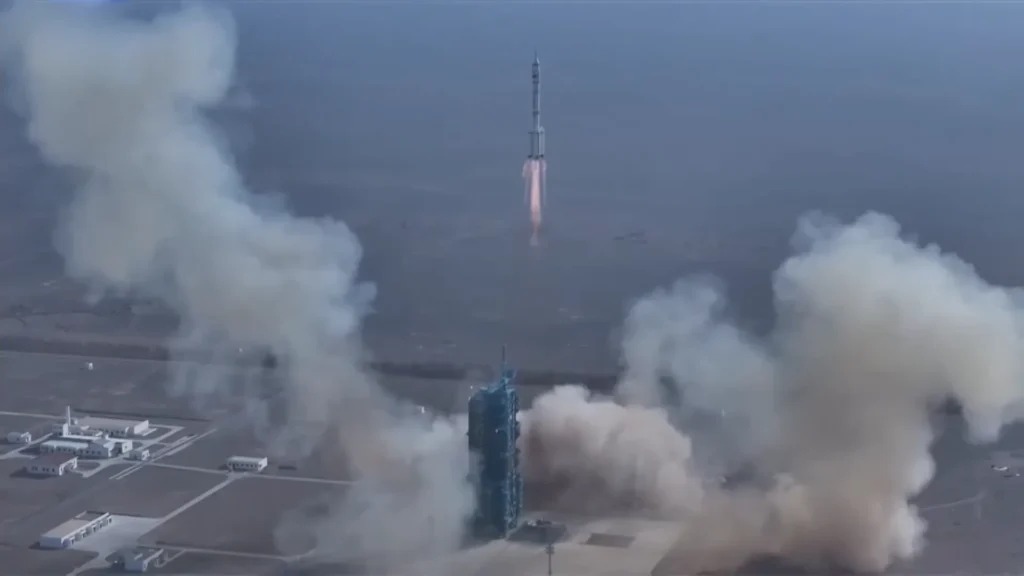
China has launched its Shenzhou-24 spacecraft carrying the first Pakistani astronaut into orbit, a flight that also marks the first time a foreign astronaut has visited China’s Tiangong space station. The Long March 2F rocket lifted off from the Jiuquan Satellite Launch Center at 8:18 a.m. Beijing time on Wednesday, and the spacecraft docked automatically with the forward port of the station’s Tianhe core module at 11:56 a.m. Beijing time, about three and a half hours later.
Muhammad Zeeshan Ali, a pilot in the Pakistan Air Force, is flying as a payload specialist. He will spend about a week aboard Tiangong carrying out scientific experiments before returning to Earth aboard the Shenzhou-23 spacecraft.
Who is flying on Shenzhou-24
The mission is commanded by Tang Hongbo, who previously flew to Tiangong on Shenzhou-12 and Shenzhou-17, making him the first Chinese astronaut to visit the station three times. He is joined by Wu Yi, a flight engineer on his first trip to space, and by Ali, whose role is built around experiments rather than piloting the spacecraft.
Ali was chosen for the flight in April, along with a fellow candidate, Khurram Dawood, who trained with him and now serves as his backup. The two were picked after three rounds of screening under an agreement signed by China and Pakistan in February 2025, which opened the way for Pakistani astronauts to train for missions to the Chinese station. Both men completed their training in China before the final crew was announced one day before launch, in keeping with the practice for Chinese crewed missions.
A week of science in orbit
During his stay, Ali will mainly work on scientific experiments carried out under the space cooperation between the two countries. His tasks include routine crew activities, setting up experimental samples and research equipment, and running scheduled experiments aboard the orbiting laboratory. The experiments are designed to run in the weightless environment of the station, where results can differ sharply from those obtained in laboratories on Earth.
Four Pakistani biotechnology experiments are among the work planned for the flight. They were selected by Chinese institutions from more than 300 proposals submitted by universities across Pakistan, and they focus on research relevant to food security and climate change. The proposals were gathered by Pakistan’s space agency, Suparco, from universities across the country. The crew will also carry out experiments in space life sciences, human physiology, microgravity physics and new space technologies.
A first for China’s space programme
Shenzhou-24 is the 18th crewed Chinese spaceflight and the 24th flight overall of the Shenzhou programme. It is the first joint crewed flight in the history of China’s human spaceflight programme to include a foreign astronaut, a milestone for a station that China built and operates on its own.
For Pakistan, the flight is the country’s first participation in a crewed space mission, and it comes as the two countries deepen their cooperation in space research. Pakistan’s space programme has previously flown satellites and carried out research with Chinese partners, but no Pakistani had travelled to space before Ali. The mission also shows how China’s space station is beginning to host international partners, something its planners have long said they intend to expand. Ali is expected to return to Earth in about a week, bringing the experiments and their results home with him. More on space can be found in our Science section, with wider coverage in Technology.