
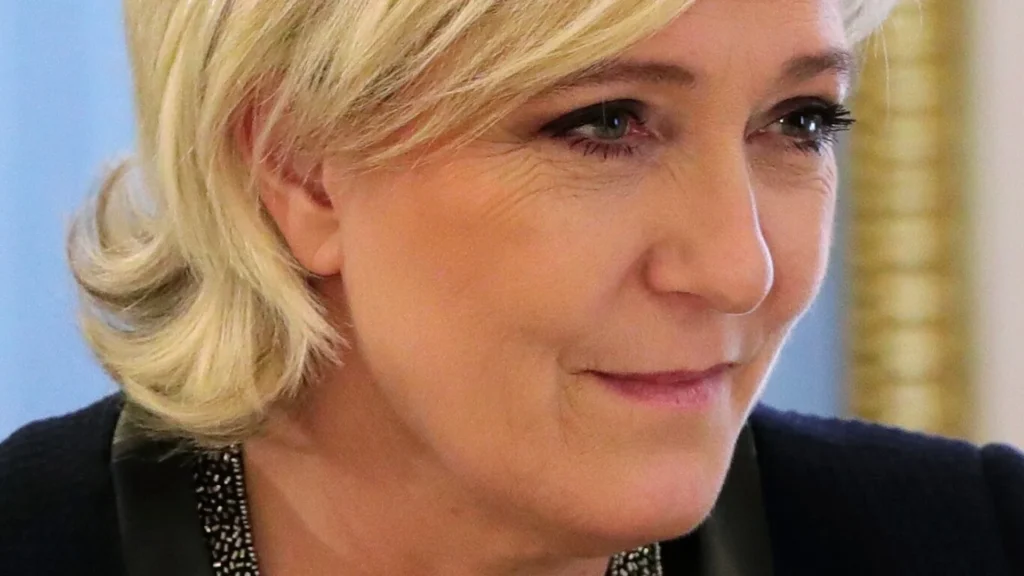
Le Pen Leads French Presidential Poll On 33 Percent Support
Last Updated on November 28, 2026 2:49 pm by Janson
Marine Le Pen holds a commanding lead in the race for the French presidency, according to a new OpinionWay poll, and would beat every rival in a second-round run-off if the election were held now.
The poll, conducted for the broadcaster CNews with fieldwork on November 25 and 26 among 912 registered voters, puts the National Rally leader on 33 percent of first-round voting intentions, up two points. Her nearest rival, Jean-Luc Melenchon of the radical-left France Unbowed, stands on 16 percent. David Lisnard of the New Energy party has climbed to third place on 12 percent, up three points, ahead of Raphael Glucksmann of Place Publique on 10 percent and Edouard Philippe of Horizons on 8 percent, down four points. Gabriel Attal and Bruno Retailleau are both on 4 percent.
The survey also tested hypothetical second-round match-ups, and Le Pen wins them all. She would beat Philippe by 59 percent to 41 percent, Melenchon by 69 percent to 31 percent, Glucksmann by 58 percent to 42 percent and Lisnard by 55 percent to 45 percent. The election is scheduled for April 18, 2027, and the poll suggests that, for now, the contest is Le Pen’s to lose.
A lead that is narrowing
The headline numbers hide a more complicated picture. Le Pen’s lead in the polling average has been shrinking: she stands at 32.8 percent in the average of recent surveys, down 1.9 points over the past 30 days and down 1.6 points in the last two weeks alone. The trend suggests that while she remains far ahead of any single rival, her support is softening as the campaign approaches and as voters focus on the cost of living, public services and the country’s political turmoil.
France has been in a state of near-permanent political crisis since President Emmanuel Macron called a snap parliamentary election in 2024 that left no party with a majority. The country has cycled through prime ministers, struggled to pass a budget and faced weeks of street protests, and the presidential race is now the contest that will decide whether the far right finally takes power. Le Pen’s party has been working for years to soften its image, presenting itself as the defender of purchasing power and public services rather than the protest movement of the past. The unrest on French streets has also been a factor, with officials saying migration remains a central concern for voters, even as net migration to Britain has fallen to its lowest level since 1997.
The rise of a rival
The rise of Lisnard is the other story of this poll. The mayor of Cannes, who leads the small New Energy party, has jumped into third place, overtaking Philippe, the former prime minister who was once seen as the main challenger from the centre-right. Lisnard’s rise suggests that some voters on the right are looking for an alternative to both Le Pen and the traditional centre-right, and his 45 percent against Le Pen in a run-off is the closest any rival has come.
What the poll does not say
Polls are snapshots, not forecasts, and the French presidential race has a habit of defying them. In 2017 and 2022, Le Pen reached the run-off and lost heavily to Macron, as voters from across the political spectrum united to block the far right. Whether that “republican front” still holds is one of the great questions of the 2027 race, and the OpinionWay numbers suggest it is weakening: Le Pen’s run-off margins are far stronger than they were four years ago.
The next few months will be decisive. The European Union’s leaders have just failed to agree on the bloc’s long-term budget, with EU leaders unable to close their budget disagreements at a summit in Brussels, and the argument over spending, defence and Ukraine will feed directly into the French campaign. For Le Pen, the challenge is to hold a double-digit lead while convincing voters she is ready to govern. For her rivals, the task is harder still: they must first find a way past each other before they can take her on.