
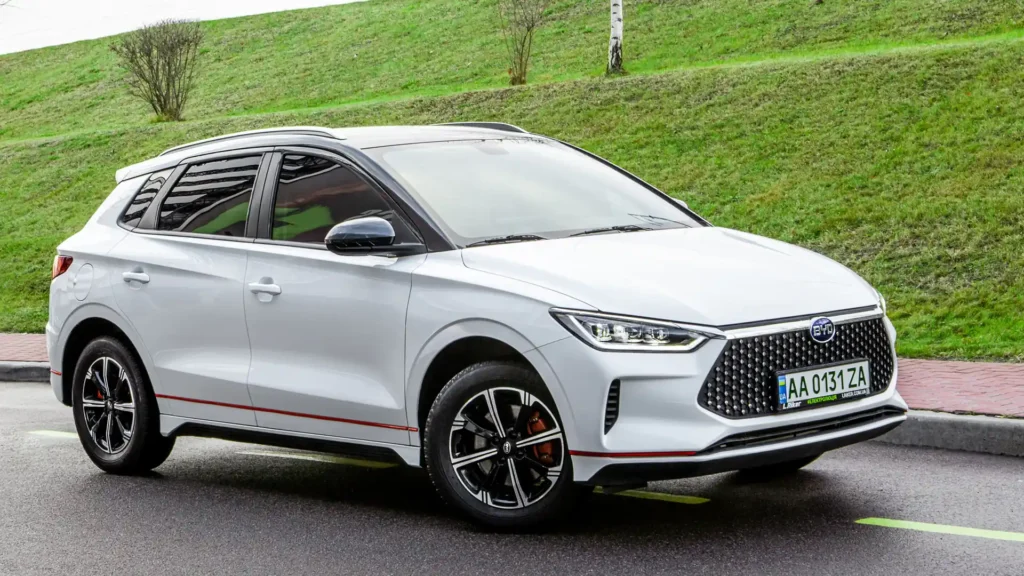
BYD Whale Electric Minivan Debuts With 559-Mile EV Range
Last Updated on November 28, 2026 12:43 pm by Janson
Chinese carmaker BYD has unveiled the Whale, a flagship electric minivan with a claimed range of more than 559 miles, as it pushes deeper into the family-car market. The seven-seat vehicle was shown for the first time at the Guangzhou Auto Show on 27 November.
The Whale becomes the flagship of BYD’s Ocean series, the line of cars aimed at younger buyers. It is the company’s most ambitious attempt yet to win over families who need space but do not want to give up electric driving, and it arrives with some of the most eye-catching numbers BYD has ever published for a single model.
A seven-seat flagship built for families
The Whale is a large vehicle by any measure. It stretches 5,270 millimetres long and rides on a 3,130-millimetre wheelbase, giving it a cabin built around seven seats. BYD says the minivan can carry seven passengers along with seven suitcases, a claim aimed squarely at families planning long trips with a full car.
The design follows BYD’s Ocean-series styling, with a smooth, rounded shape rather than the boxy look of a traditional minivan. The Whale also carries LiDAR sensors, the laser-based technology used to support driver-assistance systems, putting it among the more advanced models in BYD’s range.
Range that rivals petrol cars
The headline figure is the range. The fully electric version is claimed to travel more than 559 miles, or 900 kilometres, on the CLTC test cycle used in China. That puts it in the same territory as a petrol family car on a full tank, and well beyond most electric vehicles on sale today.
A plug-in hybrid version will also be offered, with an electric-only range of about 248 miles, or 400 kilometres, before its petrol engine takes over. Both versions use BYD’s second-generation Blade Batteries, the company’s latest battery technology, which it says is safer and more energy-dense than the cells it replaces.
Charging in minutes, not hours
Charging is the other headline. BYD says the Whale supports its Flash Charging system, which can take the battery from 10 per cent to 70 per cent in five minutes. That is among the fastest charging claims made for any production family vehicle, and it would cut the usual long stop at a fast charger down to roughly the time of a petrol fill-up.
The claim depends on using one of BYD’s ultra-fast chargers, which are still being rolled out across China. Even so, it shows how far the company has pushed charging speeds, an area where Chinese carmakers have moved faster than many of their Western rivals in the past two years.
The move comes as American chip curbs aimed at slowing China’s AI development have put a spotlight on the technology race between the two countries, and as Nvidia halted AI server shipments in Southeast Asia amid the same tensions. BYD’s progress in batteries and charging underlines how far ahead Chinese firms have moved in electric vehicles.
Price and launch plans
BYD plans to launch the Whale in China in the first quarter of 2027. Pricing is expected to start at around 300,000 yuan, roughly 45,000 US dollars, which would place it at the premium end of the minivan market in China.
The company has not yet said whether the Whale will be sold outside China. BYD has been expanding rapidly in Europe and other markets, and a large electric family car would fit its growing line-up, but for now the launch is a domestic one.
Why it matters for BYD
The Whale matters because it shows BYD moving beyond the small and mid-size cars that made it China’s biggest electric vehicle maker. Minivans are a popular choice for large families in China, and a premium electric model with a 559-mile range gives the company a new segment to lead.
It also sets a new benchmark for range and charging that rivals will have to answer. If BYD can deliver the claimed figures at the expected price, the Whale could become one of the most important new electric cars of 2027.