
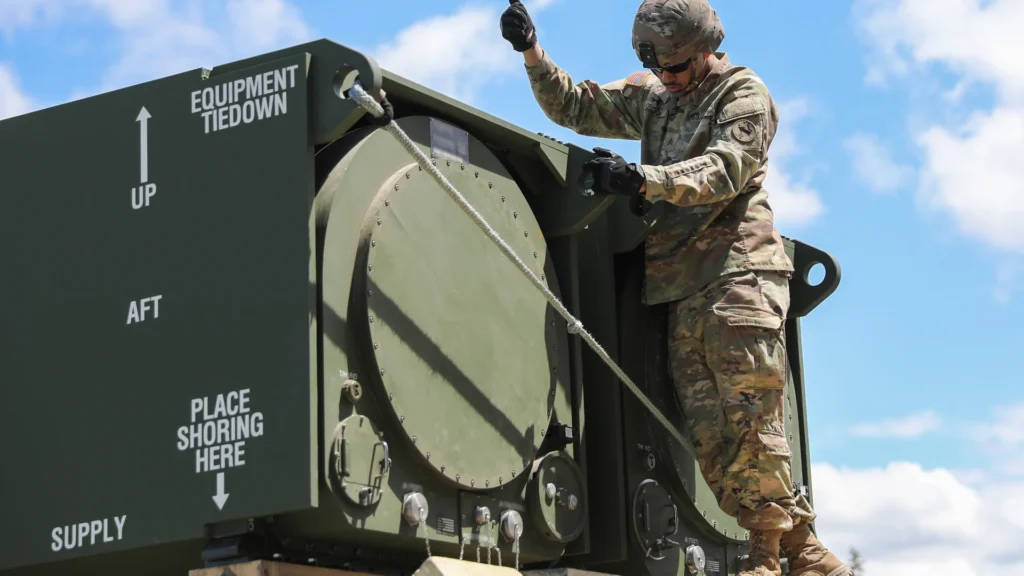
US Army Fields First Dark Eagle Hypersonic Missile Battery
Last Updated on November 28, 2026 2:49 pm by Ayesha
The United States Army has fielded its first hypersonic missile battery, ending a development effort that ran almost three years behind schedule and giving American ground forces a weapon that can strike targets more than 2,700 kilometres away at over five times the speed of sound.
Lieutenant General Frank Lozano, the Army’s senior acquisition official for long-range fires, confirmed the milestone in an interview with Breaking Defense on November 19, with the news reported on November 25. “It is fully fielded. It is ready to go,” Lozano said, describing the battery as a globally deployable warfighting capability. The system, formally known as the Long-Range Hypersonic Weapon, is called Dark Eagle by the Army and is the first ground-based hypersonic weapon in the American arsenal.
A standard battery carries eight missiles on four trailer-mounted launchers, alongside an operations centre and support vehicles. The weapon pairs a two-stage rocket booster with an unpowered glide vehicle that travels at more than 6,100 kilometres per hour, fast enough to cross the distance from London to Moscow in roughly half an hour. Unlike a cruise missile, the glide vehicle is boosted high into the atmosphere and then steers itself toward its target at hypersonic speed, making it extremely hard for air defences to intercept.
Three years late, and still secretive
The Army originally planned to field the first battery in 2023, but testing setbacks, including a mechanical fault with the launcher, forced repeated delays. A revised target of September 2025 was also missed, and as recently as October this year the programme office told reporters that training and readiness work remained before the system could be declared fully fielded. A Government Accountability Office assessment in July found that the Army and Navy had paused production to fix problems found in testing, and that prime contractor Lockheed Martin continued to have issues at its production facility.
Lozano declined to say exactly when or where the battery reached full operational status, citing operational security, and the Army has not named the unit that will operate it. Soldiers of the 5th Battalion, 3rd Field Artillery Regiment, part of the 1st Multi-Domain Task Force at Joint Base Lewis-McChord in Washington state, have trained on the system since 2021, and troops deployed with Dark Eagle to Guam during the Valiant Shield exercise in June and July this year. The Army’s drive to bring new weapons into service has also seen the Pentagon talking to carmakers about military drone parts, as the services race to modernise.
A successful test, at last
The programme did pass a major test in December 2024, when the Army and Navy completed a successful end-to-end flight of the missile and its ground equipment from Cape Canaveral in Florida. In October 2025, the Pentagon’s test office approved the programme’s master test strategy, clearing the way for further operational assessments.
What comes next
Two more batteries are already in production, and Lozano said the Army is more than halfway through building the third, with both expected to reach full capability faster than the first. The Pentagon’s test office said the Army intends to field them by the final quarter of fiscal year 2028. The weapon’s arrival matters because it gives the Army a long-range strike option it has never had before, a mission long dominated by the Air Force and Navy, and one that commanders in the Pacific have been asking for as tensions with China grow.
The system has already been discussed as a tool for the Middle East. In April, US Central Command asked for Dark Eagle to be sent to the region during the war with Iran, according to Bloomberg, marking the first time Washington considered deploying the technology in a conflict. For now, the Army has said only that the battery is ready to go wherever it is ordered. The milestone closes one of the longest-running delays in the Pentagon’s modernisation programme, though questions remain about production, cost and how quickly the next batteries will follow. Even the Army’s own handling of old munitions shows how carefully it manages its arsenal, as seen when the Army detonated a stockpile of explosive material in Iowa earlier this year.