
Turkmenistan Transit Cargo Jumps 15% as Trade Corridors Grow
Last Updated on November 28, 2026 3:42 pm by Tayyab
Transit freight through Turkmenistan rose 15 per cent in the first ten months of 2026, as the Central Asian state turned its position between East and West into growing volumes of cargo bound for 106 countries.
The State Customs Service said more than 18 million tonnes of cargo passed through Turkmenistan’s border crossing points between January and October, a rise of 10 per cent on the same period last year. Transit freight alone exceeded 6.6 million tonnes, up 15 per cent year on year, while cargo linked to the country’s own exports and imports grew 8.5 per cent.
The customs service put the growth down to the modernisation of border infrastructure: wider throughput at checkpoints, modern control and inspection equipment, and digital technologies to speed vehicles through. The figures were published on 26 November, days after Ashgabat hosted an international conference on transport and transit corridors.
A corridor between continents
Turkmenistan sits on the Caspian Sea’s eastern shore, sharing borders with Kazakhstan and Uzbekistan to the north and east and Iran and Afghanistan to the south, and its government has spent years marketing that geography as a transit bridge between China, Central Asia and Europe. The strategy is paying off in the numbers: in the first half of 2026 alone, cross-border freight topped 10.5 million tonnes, and transit traffic along the Middle Corridor, the route that bypasses Russia via the Caspian, grew by more than 25 per cent this year.
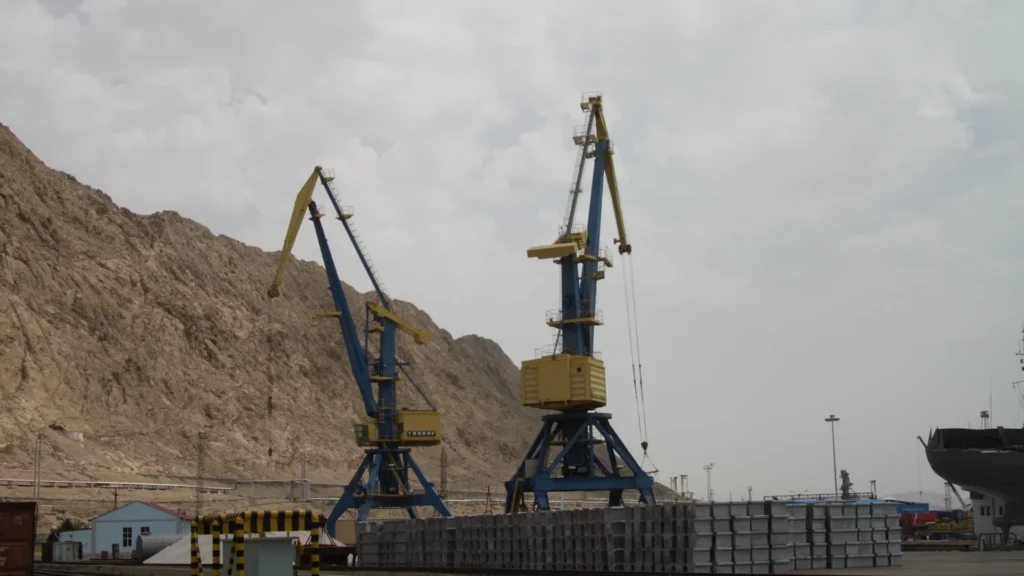
The International Seaport of Turkmenbashi is central to the plan. The port has an installed capacity of 17 million tonnes of cargo and 400,000 containers a year, and its utilisation rate has climbed from 19 per cent in 2023 to 43 per cent in 2025, according to World Bank data cited at the Ashgabat conference. Turkmenistan already exports 2.2 million tonnes of cargo through the route, more than a third of its non-gas exports.
Road and rail links are being built to match. The 600-kilometre Ashgabat to Turkmenabat high-speed motorway was completed in April 2026, a 44-kilometre section of the Turkmenbashi to Garabogaz to Kazakhstan border road has been commissioned, and construction began on 4 November on the 546-kilometre Ashgabat to Dashoguz motorway.
Growth beyond gas
The transit boom matters because Turkmenistan’s economy is heavily concentrated: mineral fuels account for about 90 per cent of exports, and China takes around three-quarters of them, with about 40 billion cubic metres of gas flowing east each year. Transit fees and logistics services offer a way to earn from geography rather than geology, and the government has made the sector a priority.
Official data show the transport and communications sector grew 13.6 per cent in the first ten months of the year, with freight transport plans fulfilled at 108.5 per cent. The economy as a whole grew 6.3 per cent in the first half of 2026, led by transport and communications, trade and services, with capital investment of 18.6 billion manats, about 5.3 billion dollars.
Still a long road
For all the growth, Turkmenistan remains a small player in global logistics, and its state-directed economy, fixed exchange rate and limited openness mean the transit story depends heavily on government investment and on neighbours keeping their corridors open. China’s markets have surged this week on hopes of stronger demand, which would help any corridor carrying Chinese goods west.
But the direction is clear: a country once known mainly for gas is steadily becoming a transit hub, and 6.6 million tonnes of freight in ten months is the clearest evidence yet. Energy markets have been volatile around the region’s conflicts, yet the trucks, trains and ships moving through Turkmenistan kept coming, and in greater numbers than a year ago.