
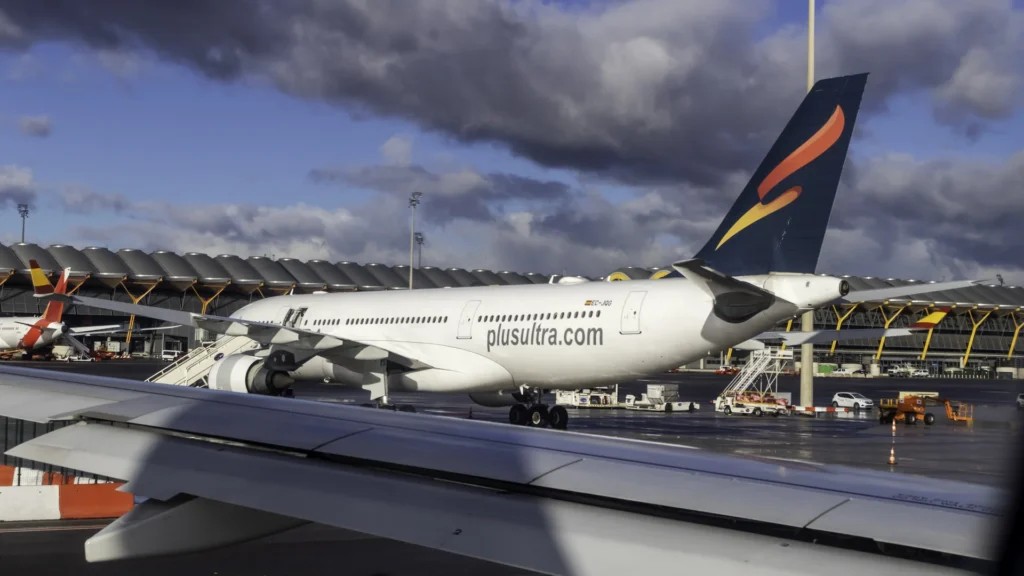
Plus Ultra to Lay Off All 659 Staff as Airline Collapses
Last Updated on November 28, 2026 3:42 pm by Alexa
Spanish airline Plus Ultra is to lay off its entire workforce of 659 employees after failing to find a buyer or an investor, its cabin crew union has said, bringing a troubled chapter in Spanish aviation to a bleak end weeks before Christmas.
The SITCPLA union said on Friday that the long-haul carrier would make all of its staff redundant, a far sharper cut than the redundancy plan it first outlined earlier this year, when it proposed shedding around 40 per cent of its workforce. The announcement comes days after Plus Ultra cancelled its last remaining scheduled route, leaving it with no flights at all and no obvious path back to flying.
Plus Ultra had already suspended all of its flights this year as it tried to restructure its debts, and the search for a buyer or fresh investor has now run out of road. The union said the airline had not provided enough documentation about its assets for severance payments to be calculated, and warned that the timetable for the layoffs lands just weeks before Christmas, when household spending typically rises and finding new work is hardest.
A bailout that could not save it
The airline was rescued by the Spanish state in 2021, when it received a 53 million euro public bailout during the pandemic, and it has since been negotiating with creditors after missing part of its repayment obligations. That rescue is now under investigation by Spain’s High Court as part of a probe into former prime minister Jose Luis Rodriguez Zapatero over alleged influence peddling, which he denies.
Plus Ultra filed for preliminary creditor protection at the Madrid Commercial Court on 13 November, blaming soaring jet fuel prices for its collapse. Under Spanish insolvency law, the filing gave it three months to negotiate a restructuring with creditors before being forced into involuntary liquidation, but the failure to find a buyer has made that rescue unlikely.
The carrier, founded in 2011, operated a fleet of seven Airbus A330 aircraft from Madrid-Barajas airport on long-haul routes to South America and Africa. In the first half of 2026 it posted an operating loss of 31.08 million euros, after its spending on jet fuel rose from a budgeted 69.13 million euros to about 104.83 million, driven by the war in Iran and the closure of the Strait of Hormuz.
One of several airline casualties
Plus Ultra is not the only small carrier to have been pushed under by fuel costs this year. Magnicharters was declared bankrupt in early November, and AlbaStar filed for insolvency after cancelling its Mallorca flights, leaving a string of failures across Europe’s leisure and long-haul market. For Spain, the loss of Plus Ultra removes a carrier that once linked Madrid with Caracas, Buenos Aires and Lima, routes that larger airlines have been slow to pick up.
The airline had already cut all but two routes, Madrid to Caracas and Madrid to Tenerife North, before suspending operations entirely and abandoning even those. Avianca has offered to rebook affected Plus Ultra passengers travelling between 18 November and 2 December at no extra air fare, though taxes and administrative charges still apply.
What happens to the workers
For the 659 employees, the question now is what severance they will receive and when. The union has demanded full documentation of the airline’s assets, arguing that without it, workers cannot know whether the money exists to pay them what they are owed. Big deals elsewhere in the corporate world have moved quickly this week, but for Plus Ultra’s staff the wait is likely to be long, with the creditor protection process still to run its course and the aircraft, the company’s most valuable assets, likely to attract interest from buyers looking to lease them out rather than restart the airline.
The closure also leaves a bitter taste for Spanish taxpayers, who funded the 2021 rescue that was supposed to keep the airline flying. Spain’s economy has cooled on other fronts too, and the sight of a bailed-out carrier collapsing entirely, with its workers facing Christmas without jobs, is likely to fuel a long argument about whether the public money was ever well spent.