
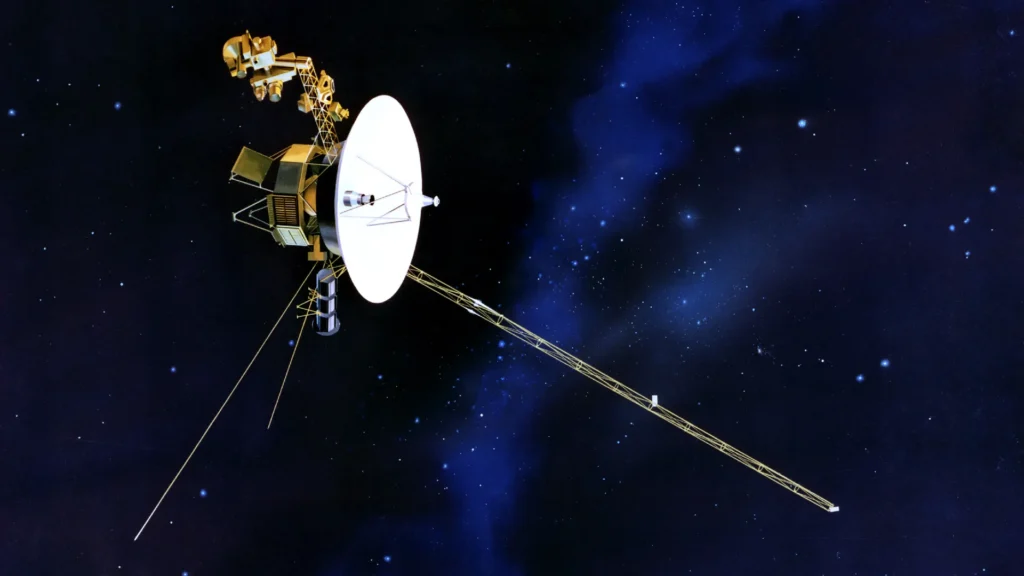
Voyager 1 Falls Silent Just As It Reaches One Light-Day Away
Last Updated on November 26, 2026 4:52 pm by Bilal
NASA’s Voyager 1 has become the first human-made object to travel one light-day from Earth, a distance so vast that a radio signal moving at the speed of light now takes a full 24 hours to reach it. The milestone arrived with a worrying catch: the spacecraft has stopped sending back its science data.
The probe crossed the threshold at 5:16am Eastern time on Wednesday 18 November, according to NASA’s Jet Propulsion Laboratory, which runs the mission. A light-day is about 16.1 billion miles, or 25.9 billion kilometres, from Earth.
Because of that distance, engineers did not hear confirmation until a day later. The team confirmed the crossing by tracking the spacecraft’s carrier signal and calculating its trajectory, even though no data was arriving on it.
Silence on the data channel
The problem was detected on 14 November, when an antenna near Canberra picked up Voyager 1’s carrier signal, the radio tone that normally carries its data, but found no data on it. The spacecraft is still sending the carrier, which means its navigation computer is keeping it pointed at Earth and its antenna and transmitter still work.
The missing data points to trouble with the onboard computer that gathers readings from the instruments and packages them for transmission. NASA has not yet confirmed which system is at fault, but the episode closely resembles one that struck exactly three years earlier, on 14 November 2023, when a faulty memory chip in the flight data subsystem stopped the probe sending usable data for months.
On that occasion engineers diagnosed the problem remotely and worked around the damaged chip, and data began flowing again in mid-2024. The team is taking the same approach now. “We have an anomaly that is not unseen before,” Voyager project manager Suzanne Dodd told a NASA news conference, adding that she was confident the data would start flowing again.
A slow-motion repair job
Fixing anything on Voyager 1 is painfully slow. Every command takes about 24 hours to reach the spacecraft, and any reply takes another 24 hours to come back, so each test takes roughly two days and a full diagnosis could stretch over weeks.
The probe also went completely silent for two days in late October, sending no signal at all before its carrier returned on 20 October. NASA is investigating whether that outage is connected to the latest fault.
“It’s never happened before, and it may never happen again, it’s that kind of extraordinary,” Voyager mission manager Kareem Badaruddin said of the light-day milestone.
Forty-nine years and still flying
Voyager 1 launched in September 1977, shortly after its twin, Voyager 2, and has now been flying for more than 49 years, far beyond its original mission. It is travelling at about 38,000 miles per hour, heading in the general direction of Gliese 445, a star more than 17 light-years away.
Age is the mission’s biggest enemy. The spacecraft runs on radioisotope generators that turn heat from decaying plutonium into electricity, and each one loses about four watts of power a year. The generators supplied 470 watts at launch and now produce roughly 210 watts. Engineers have repeatedly switched off systems to stretch the supply, and only two of Voyager 1’s ten science instruments are still returning data.
Space news this week also includes close-up images of the asteroid Dimorphos from Europe’s Hera mission, and China’s Shenzhou-24 carrying its first Pakistani astronaut.