
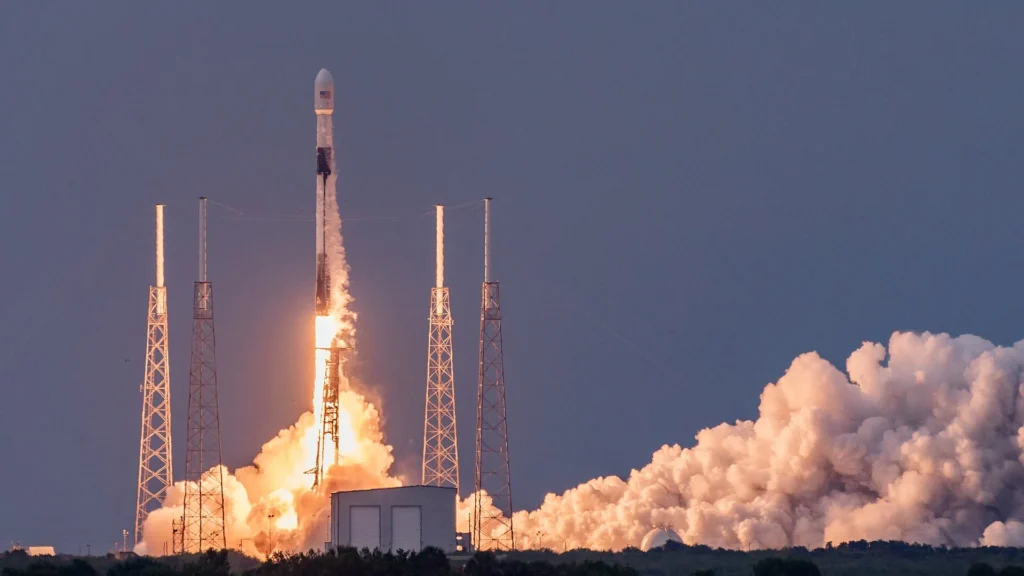
FCC Clears SpaceX To Launch A Million AI Data Satellites
Last Updated on November 28, 2026 4:18 pm by Ayesha
The United States has given SpaceX the green light to deploy up to one million satellites that would work as data centres in space, in a decision the regulator called a historic first and scientists greeted with scepticism and alarm.
The Federal Communications Commission announced on Wednesday, November 25, that it was authorising the company’s proposed Starmind constellation, a network of orbital compute modules designed to process massive amounts of data for use on Earth. SpaceX had sought permission earlier this year to deploy as many as one million satellites, and the agency said the approval would help meet rapidly growing demand for artificial intelligence computing.
FCC Chairman Brendan Carr announced the decision on X, calling it “a historic first” and saying the project “promises to bring the human race closer to a Kardashev II civilization, one that can harness the full power of the sun.” Elon Musk responded that the approval “will be a great asset to America and the world.”
The scale of the plan is hard to grasp. Only about 17,000 satellites of all kinds exist in orbit around Earth today. A million Starmind modules would expand that number by nearly 60 times if the constellation were fully deployed, dwarfing even SpaceX’s own Starlink network.
Strict deadlines, and a waived bond
The authorisation is not a blank cheque. The FCC’s order, a 14-page grant known as DA 26-1273, sets a deployment schedule that SpaceX must follow to keep its licence, and the licence becomes null and void if a milestone is missed. The company must have at least one satellite deployed, placed in its assigned orbit and operating by November 2033, then 100,000 satellites, or 10 percent of the constellation, by November 2035, half a million by 2038, and the full million by November 2040.
The licence term is 15 years, starting once the first satellite is successfully placed in orbit and its operations meet the conditions of the approval. The satellites would operate in six orbital shells spanning altitudes from 500 to 1,002 kilometres, at 30-degree and sun-synchronous inclinations.
What the FCC actually licensed is narrower than the headline suggests. The grant covers radio links for backup and emergency telemetry, tracking and command in two Ka-band slices, on an unprotected and non-interference basis. SpaceX told the regulator that the radios are cold backup only, and that the nominal number of space stations transmitting by radio at any one time is zero. The agency also waived the usual surety bond requirement, so the bond for the project is zero dollars.
Objections from Amazon and astronomers
The approval came despite objections. Amazon, which is building its own satellite network, asked the FCC to block the plan, and astronomers raised concerns about orbital debris and the effect of so many bright objects on the night sky. The regulator granted the application anyway, framing the decision around keeping the United States ahead in the global race for artificial intelligence.
SpaceX argues that putting data centres in orbit is a greener and cheaper alternative to land-based server farms. According to the company’s regulatory filings, each satellite would draw an average of 175 kilowatts for its computing payload, with a peak of 250 kilowatts, all powered by sunlight. The company has reportedly aimed to start launching the satellites next year, although how it would build and launch a million of them remains unclear.
Will a million satellites ever fly?
Scientists are sceptical about whether the full constellation will ever fly. The deployment schedule is steep, the debris risk is real, and the economics of launching a million satellites, each carrying powerful computing hardware, have never been tested. For now, the approval is a statement of intent as much as a licence: the United States has decided that the future of computing may be in orbit, and it has given its most ambitious rocket company permission to try.
The decision ties SpaceX ever more closely to the AI boom, as Musk says Google wants to rent more computing capacity from SpaceX, while the wider AI industry keeps fighting its own battles, with OpenAI countersuing Apple over trade secrets.