
Hubble Maps Milky Way’s Crowded Heart for Roman Telescope
Last Updated on November 26, 2026 8:11 pm by Usman
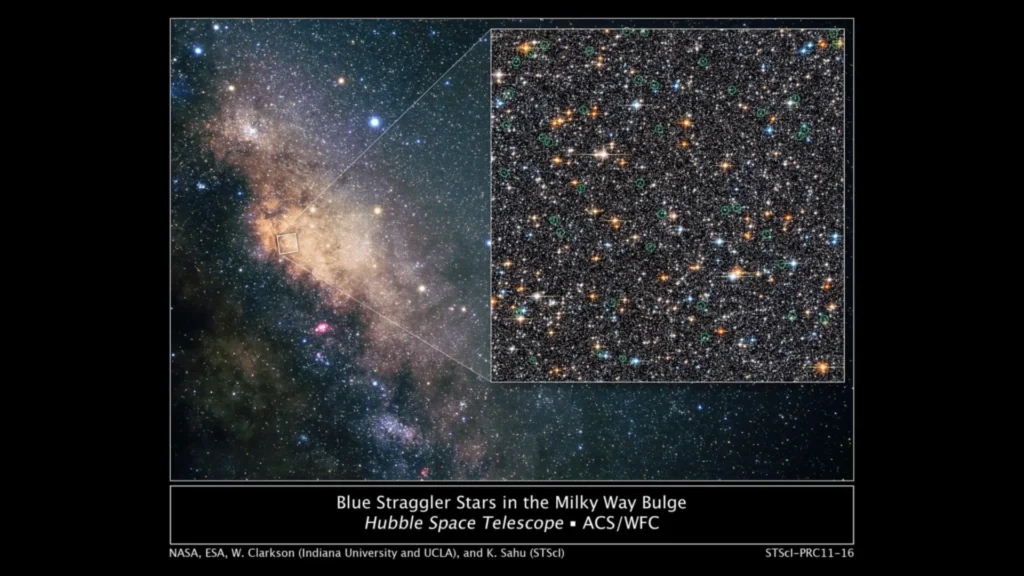
NASA has released new Hubble Space Telescope images of the crowded heart of the Milky Way, showing a field of stars so dense that points of blue, white and orange light cover almost every pixel. The pictures look toward the galactic bulge, the roughly spherical mass of stars wrapped around the centre of our galaxy, which holds nearly a quarter of the Milky Way’s total stellar mass.
The images are far more than a pretty picture. They are the groundwork for the Nancy Grace Roman Space Telescope, which launched on 30 August 2026 and will begin watching the same patch of sky in spring 2027, hunting for planets beyond our Solar System by catching the moments when their gravity briefly brightens a distant star.
A catalogue of 25 million stars
The new observations come from Hubble observing program 17776, led by Sean Terry of the University of Maryland. The survey covers 354 fields across 177 visits, spanning about 1.1 square degrees of sky, and is expected to produce a catalogue of roughly 25 million stars.
Hubble looked at the region in red visible light and near-infrared light, the wavelengths that overlap with what Roman will see. That matters because researchers want to compare the two telescopes’ views directly: Hubble’s sharp vision can separate stars that would otherwise blend together, giving astronomers a precise record of each star before anything unusual happens to it.
One of the most striking features of the images is a dark patch in the middle of the starfield that at first glance looks empty. Look closer, and it is full of faint points of light. Earlier Hubble work on the bulge, including the SWEEPS program that studied 180,000 stars, showed the same thing: even the apparently blank corners of the galactic centre are crowded.
Why the bulge is the perfect hunting ground
Roman’s planet search will rely largely on microlensing, a trick of gravity. When an unseen planet passes in front of a more distant star, its gravity bends and magnifies the background star’s light, causing a brief brightening that can last from hours to days. The effect is tiny, and it only works if astronomers know exactly how bright the background star normally is.
That is where Hubble’s catalogue comes in. With a measured brightness for each of the millions of stars in the field, a microlensing event gives researchers far more than a flicker of light: it lets them turn the ratio between a planet and its star into an actual mass for the planet. Without that baseline, a detection would remain a curiosity. With it, it becomes a measurement.
The bulge is the ideal place to run this experiment because the stars are packed so tightly together that the chances of one passing in front of another are far higher than anywhere else in the galaxy. Roman will watch the same fields again and again, and every brightening it records will be read against Hubble’s map.
What happens next
Roman’s Galactic Bulge Time-Domain Survey will begin in spring 2027, and its observations will be compared with Hubble’s baseline for months and years afterwards. The haul could include new exoplanets, including worlds that would be almost impossible to find any other way, as well as black holes and neutron stars betrayed by the same lensing effect.
For Hubble, now more than three decades into its mission, the survey is another reminder of how the telescope keeps enabling the next generation of astronomy. Its images of the galactic centre will be the reference that Roman’s discoveries are measured against, long after the new telescope starts its watch.
Space science is delivering a steady stream of firsts. Europe’s Hera mission has photographed a stadium-sized crater on the asteroid Dimorphos, as our report on the Hera images of Dimorphos explains, while Voyager 1 has now travelled more than a light-day from Earth and fallen silent, covered in our report on Voyager 1 going quiet. Hubble’s map of the Milky Way’s heart may be the most useful of them all, because it is the key to everything Roman is about to find.