
Hera Images Show Stadium-Sized Crater on Asteroid Dimorphos
Last Updated on November 26, 2026 11:39 am by Tayyab
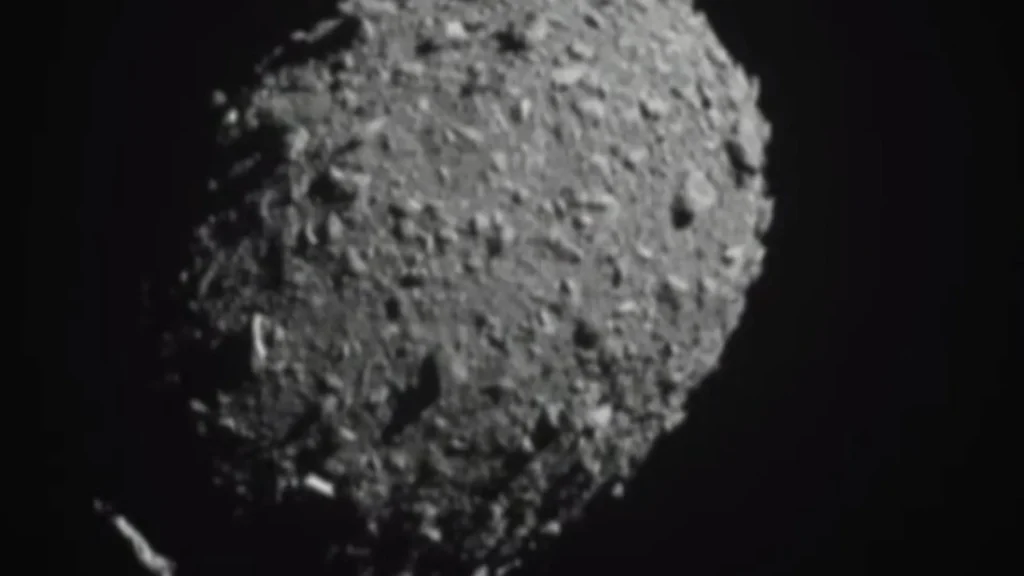
The European Space Agency has released the first close-up images of the asteroid Dimorphos, the small space rock deliberately struck by a NASA spacecraft in 2022, and they show a world transformed by the impact. One face of the asteroid has been flattened into a crater the size of a sports stadium, and the battered rock is now tumbling chaotically as it orbits its larger companion.
The images were taken by ESA’s Hera mission, which arrived at the double-asteroid system in October to carry out a detailed survey of the aftermath of humanity’s first planetary defence test. Scientists say the pictures answer questions they have debated for four years, and they contain surprises nobody expected.
A flattened face and a giant crater
Dimorphos is a moonlet about 151 metres across, orbiting a larger asteroid, Didymos, which measures about 730 metres. On 26 September 2022, NASA’s DART spacecraft slammed into Dimorphos at about 6.1 kilometres a second in a test of whether a spacecraft impact could change an asteroid’s orbit.
The new images show that the face struck by DART has been flattened into an impact crater that stretches across the asteroid’s entire width. Inside the crater, scientists can see large exposed boulders, including what appears to be a cigar-shaped structure at its centre. The rest of Dimorphos looks much as it did in DART’s own final images, with boulder fields covering the regions that were not directly hit.
Tumbling through space
One of the biggest surprises in the images is that Dimorphos is no longer spinning in a stable way. As more pictures came back from Hera, it became clear that the impact has left the asteroid tumbling wildly in its orbit around Didymos, wobbling in a way that was not predicted before the mission arrived.
The tumbling matters because it changes how scientists understand the way the impact’s energy was shared out. Some of it went into changing the asteroid’s orbit, some into throwing material off the surface, and some into deforming the asteroid itself. Working out the balance between those effects will help researchers estimate how effective a spacecraft impact would be as a way of deflecting a dangerous asteroid.
A swarm of new boulders
The Hera images also reveal that the two asteroids are surrounded by hundreds of previously unknown boulders, each only a few metres across, drifting in orbit around the pair. The team had expected to find some loose boulders, but the sheer number caught them by surprise.
The swarm creates a genuinely dynamic environment around the asteroids, and the mission team will have to take the objects into account in the coming weeks as Hera moves in closer to take higher-resolution images. The spacecraft is currently flying about 25 to 30 kilometres from the asteroids, using its thrusters to hold rectangular orbits around the pair at a speed of only about 12 centimetres a second.
Why the crater matters for planetary defence
The DART impact had already proved its main point: it shortened Dimorphos’s orbit around Didymos by 33 minutes, far more than predicted. Hera’s job is to find out exactly what happened to the asteroid itself, so that a future deflection mission can be planned with confidence rather than guesswork.
Hera will move closer to the asteroids in December, and in January it will deploy two shoebox-sized CubeSats that will venture closer still. The first images were unveiled at the dinosaur hall of the Natural History Museum in Berlin, a deliberate choice and a reminder of why the work matters: an asteroid impact is widely believed to have ended the age of the dinosaurs, and the goal of planetary defence is to make sure it never happens again.