
Global Rivers and Lakes Fell Sharply in the Hottest Years
Last Updated on November 27, 2026 9:32 am by Sara
Extreme global heat in 2023 and 2024 triggered an unprecedented decline in the planet’s surface freshwater, with river flows and lake and reservoir storage falling sharply even in humid regions, according to a major study.
Published in the journal Science on 26 November, the research found global river discharge fell by about 5.7 percent below the long-term average during the two hottest years on record, while water stored in lakes and reservoirs dropped by 9.5 percent. Together, it was the largest synchronised decline in surface water since at least 1991.
The findings underline a critical vulnerability in global water security, and challenge a common assumption: that a warmer atmosphere, which holds more water vapour, automatically means more water on land.
The scale of the loss
The team, led by Yongqiang Zhang of the Chinese Academy of Sciences with senior author Gunter Bloschl of TU Wien, analysed discharge from 150 large river basins and satellite data on more than 1.2 million lakes and reservoirs, reconstructing global water availability from 1991 to 2025 with hydrological models and machine learning.
They identified three phases: sharp fluctuations from 1991 to 2006, relative stability from 2007 to 2022, then an abrupt fall in 2023 and 2024, by about 2,040 cubic kilometres of river flow a year and about 640 cubic kilometres of lake and reservoir storage.
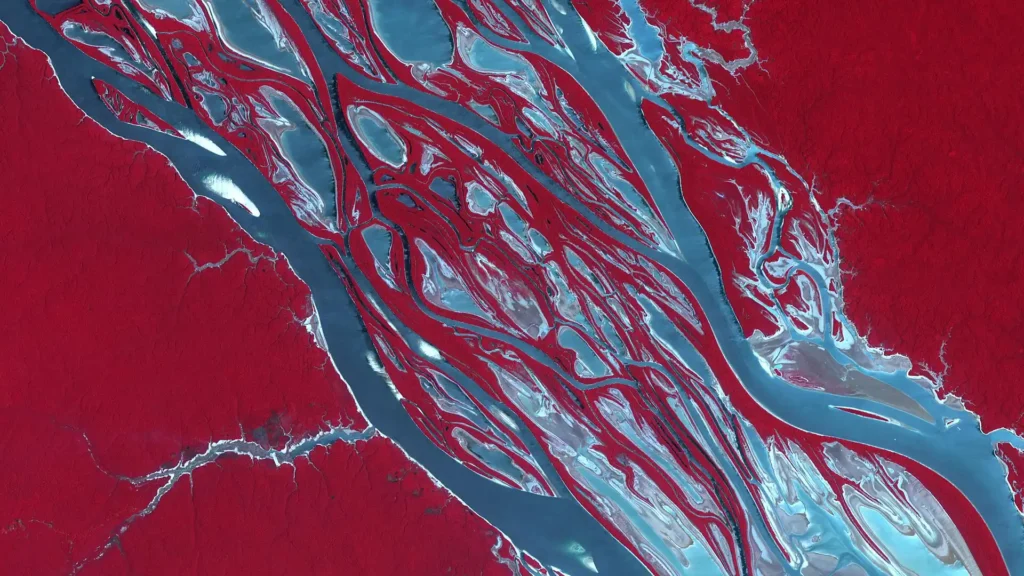
South America was hit hardest, accounting for 70 percent of the global decline in river flow, which fell there by about 18 percent, with lake and reservoir storage down about 16.5 percent, and the Amazon basin recording its lowest flow in four decades. The Rio Negro at Manaus fell to its lowest levels in over a century, disrupting transport, isolating communities and putting wildlife at risk.
The paradox: a wetter sky, a drier land
The study’s most striking finding is a paradox: global rainfall actually rose during the two hot years, but the extra rain fell over the oceans. Land received about 1,360 cubic kilometres a year less rain than normal, even as the sky above it grew wetter.
“The findings highlight an important paradox of climate change: a warmer atmosphere does not necessarily mean more water is available on land,” said Dr Sulagna Mishra, one of the study’s authors.
The explanation lies in how the atmosphere moves water around: a warmer atmosphere holds more vapour, but where it falls as rain depends on large-scale circulation, and in 2023 and 2024 that circulation kept rain away from land, and from South America.
El Nino was the trigger, the Atlantic the amplifier
The researchers traced the decline to an unusual combination of two warm oceans. A strong El Nino warmed the tropical Pacific, while at the same time the tropical North Atlantic was exceptionally warm. Together, they altered the large-scale atmospheric circulation: air sank more strongly over South America, and moisture was drawn away from the continent, suppressing rainfall.
“El Nino was the trigger, and the warm Atlantic was the amplifier,” Zhang said. The team also found that during El Nino peaks, the tropical Atlantic now warms about 1.2 degrees Celsius more for every 1 degree of global warming, even though El Nino itself is not getting stronger, which suggests that warming may make severe El Nino-related droughts more likely by intensifying Atlantic warming.
There is one reassuring note. Total river flows recovered towards their long-term baselines in 2025, even though it was the third-hottest year on record, which shows that the 2023-2024 collapse came from a specific convergence of climate anomalies amplified by ongoing warming, rather than a permanent shift to a drier world.
But the warning stands. The study was inspired by the World Meteorological Organization’s State of Global Water Resources 2024 report, where the researchers first saw river flows and lake storage falling at the same time in many regions. The world has now spent six days more than 2 degrees above pre-industrial temperatures, and the UK’s seasons are already changing, with fewer frosts and more hot days. As the planet keeps warming, the next convergence of a strong El Nino and a warm Atlantic could drain the world’s rivers and lakes again, and the people who depend on them will feel it first.