
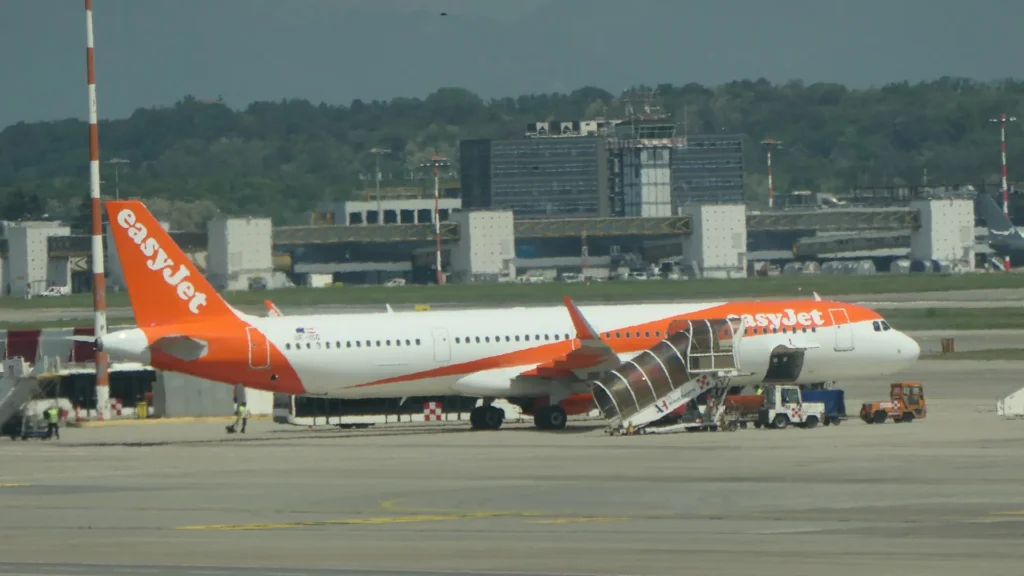
EasyJet Flight Returns to Edinburgh After Engine Emergency
Last Updated on November 27, 2026 12:11 pm by Alexa
An easyJet flight from Edinburgh to London Gatwick was forced to turn back and declare an emergency shortly after take-off on Thursday evening, after a loud bang was heard as the aircraft climbed away from the Scottish capital.
Flight U2816, an Airbus A321neo registered G-UZMC, left Edinburgh at 8:46pm on Thursday, bound for Gatwick. Within minutes, the crew halted the climb, declared a general emergency and began the return to Edinburgh. The aircraft landed safely about 53 minutes after departure, with emergency crews standing by. No injuries were reported.
What happened in the air
Residents across Edinburgh reported hearing a loud bang or explosion-like noise as the aircraft climbed to around 5,000 feet. A witness in Livingston, west of Edinburgh, wrote on social media that he heard an ‘engine blow’ over his home shortly before 9pm, and doorbell-camera footage of a bang was shared online by aviation watchers.
Automated messages sent by the aircraft to its operator, known as ACARS messages, indicated an engine stall and dangerously high exhaust gas temperatures, according to flight-tracking accounts that followed the emergency as it happened. The messages pointed to the left engine being shut down while the aircraft was at about 5,000 feet. The crew transmitted squawk 7700, the transponder code that tells air traffic control an aircraft needs immediate priority handling.
Some reports described a left engine fire indication, but that has not been confirmed by easyJet or by investigators, and a fire indication on its own does not show that an actual fire was present. The aircraft circled several times before touching down on runway 06, then taxied to a remote stand at Edinburgh Airport, where emergency personnel including police and fire crews were waiting.
The airline’s response
EasyJet said the flight ‘was required to return to Edinburgh due to a technical issue’ and that it ‘landed normally and was met by emergency services in line with procedures and a precautionary measure only’. The airline did not say what the issue was, and a replacement aircraft was arranged to operate the flight to Gatwick that evening.
Passengers faced a long wait. The replacement service was not due to leave Edinburgh until about 2:10am, more than five hours after the original departure time, while G-UZMC had no further flight listed after its return. The aircraft had already flown five sectors that day, including a round trip to Venice and one to Nice, before arriving in Edinburgh from Gatwick at about 7:38pm.
The cause of the incident has not been published, and the aircraft will need a full technical inspection before it can return to service. Investigators will examine the engine, review the flight data and cockpit voice recorders and interview the crew to establish whether the problem was a compressor surge, a bird strike or a mechanical fault. Aviation safety teams will also want to know why the engine warnings appeared so soon after take-off.
Aviation safety under the spotlight
The incident is a reminder of how quickly a routine domestic flight can become an emergency, and of how much of the safety system depends on crews following their training. An engine shutdown at 5,000 feet, in darkness, over a city, is the kind of event pilots rehearse repeatedly in simulators, and the crew’s decision to return immediately rather than continue to Gatwick on one engine followed standard procedure.
Passengers on the flight described being terrified by the bang, but the outcome — a safe landing, no injuries, and a replacement aircraft — is what the emergency procedures are designed to deliver. Norse Atlantic has suspended all its flights as it faces a possible collapse, while a Qantas flight aborted a landing in Sydney as an Air New Zealand aircraft crossed the runway — a week in which aviation safety has been in the headlines for very different reasons.