
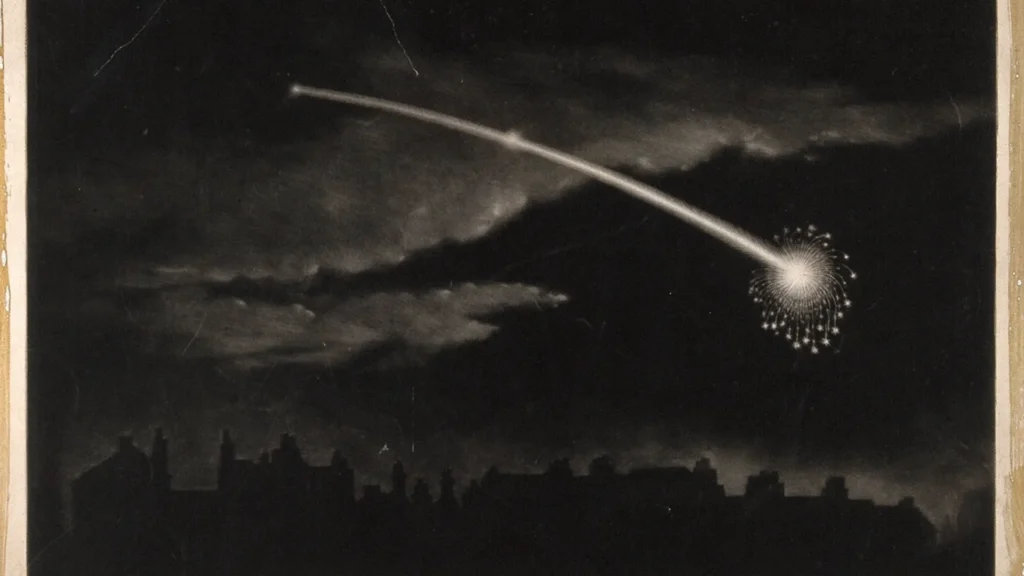
NASA Confirms Green Fireball Over Michigan Was a Meteor
Last Updated on November 28, 2026 9:11 am by Bilal
NASA has confirmed that a bright green fireball seen over Michigan on Thanksgiving Eve was a meteor, after more than 1,300 people across ten states reported the flash.
Bill Cooke, who leads NASA’s Meteoroid Environment Office, said the fireball was caused by a tau Taurid meteor. It appeared at about 7.40pm Eastern Time on Tuesday, 25 November, and was so bright that it rivalled the full moon.
A 120-pound rock from space
The meteor first became visible 67 miles above the town of Imlay in Lapeer County, Michigan, and then moved slightly south-west at 61,000 miles per hour before disintegrating 32 miles above Bath in Clinton County. At its peak, the fireball weighed more than 120 pounds and measured about 14 inches across.
Its green colour came from the metals inside it. When a meteor burns up in the atmosphere, the elements it contains glow in different colours, and high levels of nickel, magnesium and oxygen can produce a vivid green. Witnesses across Michigan, Ohio and Ontario described the light as green, though some said it looked blue, a difference that can come from where each person was standing and how bright the flash was.
Some people who saw it first thought a transformer had exploded or a power line had failed, a common reaction when a fireball lights up the night without warning. But the flash was also picked up by a weather satellite: NOAA’s GOES-19 satellite recorded it near Saginaw Bay using an instrument designed to spot lightning, which can also be triggered by a very bright meteor.
Why it happened now
The meteor belonged to the Taurid complex, a stream of debris left behind by a comet that Earth passes through each autumn. The Taurids are nicknamed the Halloween fireballs because they are known for producing unusually bright meteors, and the shower peaks in late November.
Fireballs are meteors that are brighter than magnitude minus three, bright enough to be seen in daylight or to cast shadows at night. Most meteors are the size of a grain of sand and burn up high in the atmosphere without anyone noticing. A fireball comes from a larger piece of rock, and the Michigan object was large enough to be seen across hundreds of miles.
The American Meteor Society logged more than 1,300 reports from ten states and Ontario, making it one of the most widely seen fireballs of the year. Witnesses reported it from Fort Wayne in Indiana to Niagara Falls, and weather cameras across the region caught the burst of light on video.
No damage, no fragments found
No damage or injuries were reported, and it is not known whether any fragments reached the ground. In 2018, pieces of a meteor that fell over south-eastern Michigan were recovered near Hamburg Township, but this time the rock appears to have burned up completely in the atmosphere.
Michigan has seen several notable fireballs in recent years, including one in August 2024 over Rose City and another in November 2025 over the north of the state. The Thanksgiving Eve fireball was the brightest of them, and the first to be confirmed by NASA within days.
For the people who saw it, the green flash was a reminder of how much rock is still falling from the sky. Scientists have found the deepest explosive volcanic eruption ever recorded, while a makeup bag sealed in Pompeii for 2,000 years has been opened. In Michigan, the sky put on its own show, and NASA has now explained what it was.