
Tesla Files to Acquire German Robotics Parts Maker EMAG
Last Updated on November 27, 2026 6:00 pm by Usman
Tesla has filed plans to acquire EMAG, a German supplier of precision manufacturing systems, in a move that points to the carmaker’s growing ambitions in humanoid robots. A filing with Germany’s antitrust authority, the Bundeskartellamt, showed on Friday that Tesla intends to take over the machine-tool maker, although the details of the planned transaction were not immediately disclosed.
EMAG is based in Salach, near Stuttgart in south-western Germany, and builds the machines that factories use to produce drive systems for humanoid robots. Founded in 1867, the privately owned company specialises in high-precision production equipment.
The antitrust filing follows weeks of smaller clues that Tesla was moving in on the company. Earlier in November, Tesla registered a new German legal entity, Tesla Machining Technologies Management SE, at EMAG’s own headquarters address, Austrasse 24 in Salach, with 120,000 euros in share capital. Commercial register documents dated 9 November list Tesla Germany’s sales and delivery head, Maximilian Stromberger, as managing director, alongside a robotics engineer and the head of human resources at Tesla’s Grunheide gigafactory.
Why EMAG matters for Optimus
The interest is not in EMAG’s traditional business alone. The company’s manufacturing systems are designed for the high-volume production of three core actuator parts, the flexsplines, wave generators and planetary gears that sit inside a humanoid robot’s joints. Those components must be made to extremely tight tolerances.
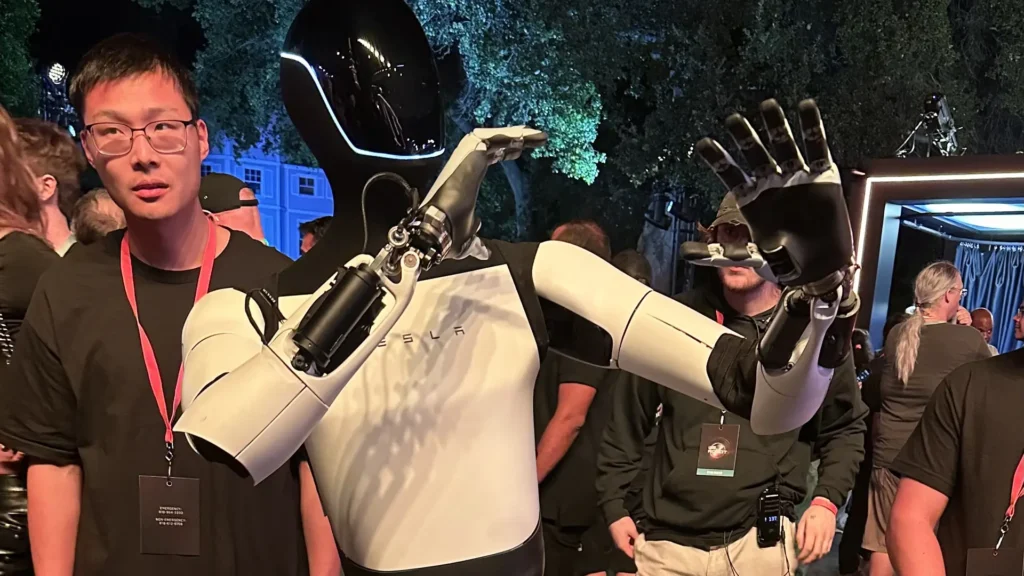
Tesla’s humanoid robot, Optimus, is moving from prototype to production. The company confirmed on 21 October that early production of the third-generation Optimus had begun on high-volume lines at its Fremont factory in California, and it is building a dedicated Optimus facility at its site in Texas. Securing a supplier that already machines robot-grade gears would remove a major bottleneck, and reports suggest around 220 EMAG specialists could move across to Tesla.
Local media in Germany reported that EMAG briefed its workforce about the plans at an internal staff meeting on 16 November. The company is understood to be restructuring and looking for investors, which makes a buyer with a clear use for its technology an attractive match. The deal is being described in the German press as an acqui-hire, an acquisition driven as much by the desire to absorb a company’s talent and technical knowledge as by its products.
A growing German footprint
The move would deepen Tesla’s manufacturing presence in Germany, where it already operates its Grunheide gigafactory near Berlin. Tesla has bought German industrial assets before, taking over the assets and workforce of the automation specialist Manz. Germany’s machine-tool industry is regarded as the best in the world, and its engineers have decades of experience building the equipment that other factories depend on.
For Tesla, the timing fits a wider strategy. The company has said that Optimus could eventually become a bigger business than its cars, and it has been steadily adding the pieces needed to build robots in large numbers. Owning the machines that make the most delicate parts, rather than buying them from a supplier, would give it more control over quality, cost and speed, and it would keep that know-how inside the company as production grows.
What is still unclear
For now, much about the deal remains unknown. The antitrust filing does not disclose a price or a timetable, and it is not clear whether Tesla would buy the whole company or take a stake and integrate its operations gradually. Regulatory approval would also be needed before any transaction could be completed, and the German authorities will examine whether the deal raises any competition concerns.
The paper trail is unusually specific for a deal that has not been announced. A registered company at EMAG’s address, a management team drawn from Tesla’s German operations, and a workforce briefing all point in the same direction, and an official announcement is now the likely next step. Mexico is separately seeking talks with US aviation authorities over SpaceX’s use of its airspace, while Washington has approved the export of 900,000 advanced AI chips to China.