
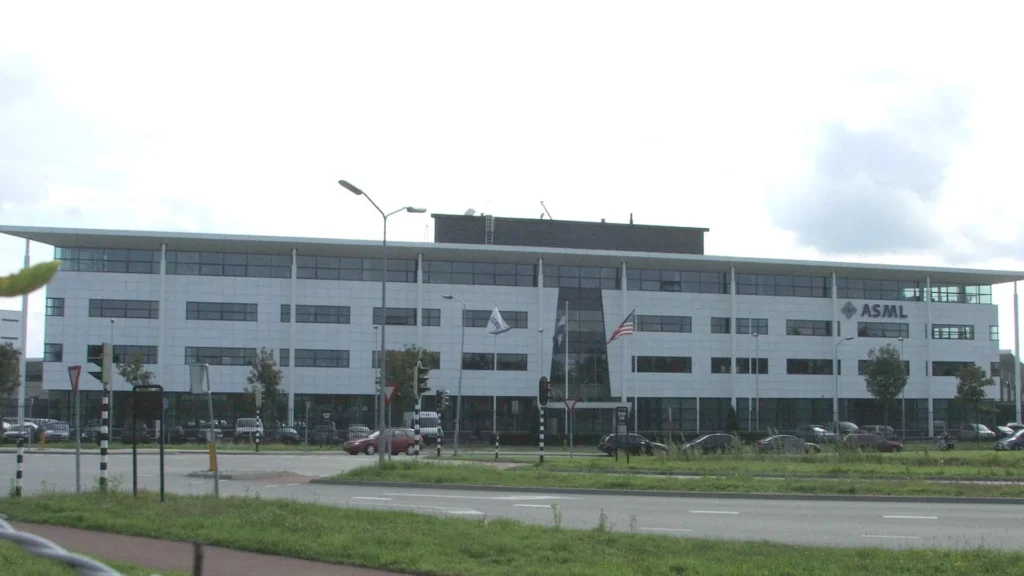
Netherlands Asks US Not to Enforce Chip Export Curbs Bill
Last Updated on November 27, 2026 7:35 am by Janson
The Netherlands will ask Washington not to enforce proposed American restrictions on exports to China that would harm Dutch technology giant ASML and other European companies if a controversial bill becomes law, the country’s trade minister has said. Sjoerd Sjoerdsma told parliament on Thursday, 26 November, that the Netherlands would push back against the measure, opening a new dispute between Washington and one of its closest allies.
We will not simply be told what to do, Sjoerdsma said during the debate. If the act is adopted, our message to the US administration will be to not enforce it. The warning centres on the Multilateral Alignment of Technology Controls on Hardware, or MATCH Act, a bipartisan bill being considered by the United States Congress. Lawmakers are negotiating whether to adopt it next month as part of the annual defence spending bill.
The legislation would force allies including the Netherlands and Japan to adopt tougher export controls on advanced chipmaking equipment supplied to China, or face unilateral American restrictions on their own equipment. That would include ASML’s immersion deep ultraviolet lithography tools, the machines that print the circuitry onto silicon wafers and that only a handful of companies in the world can build. ASML, based in Veldhoven in the south of the Netherlands, makes the world’s most advanced chipmaking machines, and it expects China to account for about 20 percent of this year’s sales.
A sovereignty dispute, not just a trade row
The Netherlands has previously aligned with American-led export controls aimed at slowing China’s ability to make its own chips, measures that already hurt ASML’s export business. But it has opposed the MATCH Act on sovereignty grounds, arguing that the bill would intrude on Europe’s authority to decide which products Dutch businesses can export. Sjoerdsma said his government was coordinating with the European Commission, Germany and France to prevent the legislation from advancing, and it may explore activating the European Union’s Blocking Statute to counter extraterritorial American measures.
Foreign Minister Tom Berendsen raised similar concerns during a visit to Beijing on 25 November, saying the Netherlands intended to retain independent control over export decisions. Dutch lawmakers had already urged their government to resist the proposal on 24 November, and Thursday’s statement represents a further escalation, with the Dutch government explicitly warning that it could seek measures to counter the proposed restrictions.
The MATCH Act was proposed in April 2026, and it represents another attempt to close perceived gaps in the system of export controls that the United States and its allies have built around advanced semiconductors. Washington argues that China is using foreign chipmaking equipment to build its own advanced chip industry, and that allies should be compelled to close the loopholes. The Netherlands argues that it has already gone far enough, and that being ordered to go further by American law is a step too far.
What happens next
For now, the dispute remains political rather than an enacted change in export law. The proposed restrictions are not yet law, and the decision on whether to include the MATCH Act in the defence spending bill is still being negotiated in Congress. But the Dutch warning has put the issue on the table in unusually blunt terms, and it comes at a moment when transatlantic trade relations are already strained by a wave of new American tariff proposals.
The stakes for ASML
If the act is adopted and Washington tries to enforce it, the Netherlands has signalled that it will not comply quietly. The Blocking Statute, which the European Union has used before to shield its companies from American sanctions, would be one tool. A court challenge would be another. For ASML and the European technology sector, the outcome will decide whether the world’s most advanced chipmaking machines can still be sold to the world’s largest chip market, or whether the next round of the technology war will be fought between allies as well as rivals. Nvidia has halted AI server shipments to Southeast Asia, while the EU has launched a 50 billion euro quantum tech fund.