
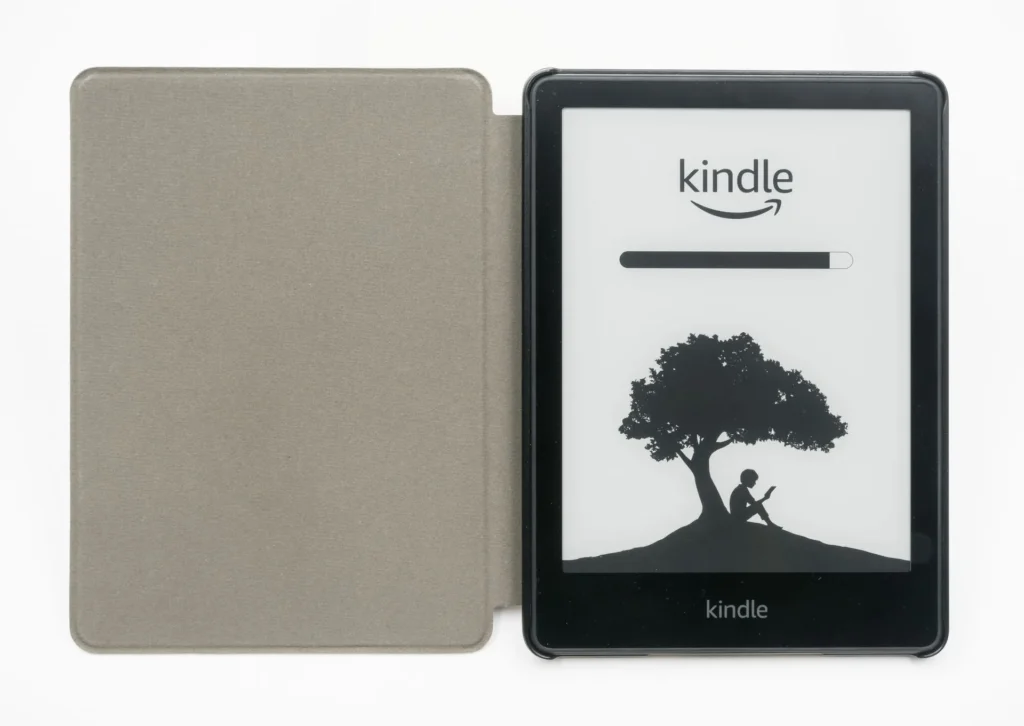
Amazon’s 2026 Kindle Paperwhite Brings Back Page Buttons
Last Updated on November 29, 2026 4:02 am by Rehan
Amazon’s 2026 Kindle Paperwhite brings back page-turn buttons, but only for readers willing to pay for them. The buttons return not on the device itself, but on an $80 cover that works only with the $250 Signature Edition, taking the total cost to $329.98 before tax.
The verdict comes from Ars Technica’s review of the new lineup, published on 28 November, which concludes that Kindles are getting costlier faster than they are getting better. The 2026 Paperwhite, announced on 1 October and on sale since 28 October, is the first Kindle in years to offer physical page turning, but Amazon has put the feature behind its most expensive model.
The flagship of the now five-model monochrome Kindle family is the $250 Paperwhite Signature Edition, which takes the core specifications of the new $200 Paperwhite and puts them in a sturdy aluminium case instead of the usual plastic. It adds 32GB of storage instead of 16GB, an auto-adjusting front light, a rotation sensor and copper contacts on the back. For another $80 on top of the $250, buyers can add the Kindle Page Turn Cover, which connects to those contacts with pogo pins and adds two long buttons on a plastic bezel. The cover needs no pairing and no extra battery, and the buttons can be swapped in settings.
The buttons cost $330, not $280
Amazon killed the Kindle Oasis on 16 October 2024, and that was the last Kindle with page-turn buttons built into the body. The new route back to buttons is expensive: the standard $199.99 Paperwhite cannot use the cover at all, so the minimum price for integrated page-turn buttons is $329.98.
There are cheaper ways to turn pages without touching the screen. A $34.99 Kindle Click remote works with the whole range, and the Signature Edition itself supports double-tap page turns, letting readers tap the sides or back of the device. The $59.99 charging dock also uses the pogo pins to hold the reader upright, but the Signature Edition has dropped Qi wireless charging, a feature the previous model had.
The rest of the hardware has barely changed. Unlike the 2021 or 2024 Paperwhite updates, the 2026 model includes no notable screen or lighting upgrades. Both the $200 Paperwhite and the $250 Signature Edition share the same 7-inch, 300 ppi screen, the same warm light, the same waterproofing and the same 12-week battery rating, so the reading experience is identical. The power button has moved from the bottom edge to the top-right edge, and the back panel now opens for a battery swap, a change Amazon has tied to European Union rules.
A $150 Kindle that is not a Paperwhite
The price ladder has shifted in a way that catches buyers out. The $149.99 base Kindle has a 6-inch screen, 16GB of storage and a six-week battery, but no warm light and no waterproofing. The 2021 Paperwhite launched at $139.99 with a 6.8-inch screen, warm light, waterproofing and USB-C. In other words, the $150 Kindle costs $10 more than the 2021 Paperwhite and offers less, and the features that defined the Paperwhite now start at $199.99.
The 2024 Paperwhite, which launched at $160, now looks like a bargain by comparison. The 2026 model costs $40 more than that, and the Signature Edition costs $50 more than the 2024 Signature Edition at launch. Amazon also sells a colour twin, the Colorsoft Signature Edition at $319.99, which shares the pogo pins and can also take the page-turn cover.
Who should buy one
For readers who simply want to read, the standard $200 Paperwhite remains the sensible choice, with the same screen and battery as the premium model. For longtime button holdouts, the Signature Edition plus cover is the only way back, and it is a lot of money for two buttons.
The review’s broader point is hard to argue with: the new Kindles cost more and do little more. Black Friday discounts may narrow the gap, but the structure is clear, and it mirrors a wider pattern in consumer tech, where Sony’s flagship headphones hit a record low of $348 for Black Friday even as Google made 1080p video free for all Meet web users. For Kindle fans, the buttons are back, but Amazon is charging a premium for the privilege.