
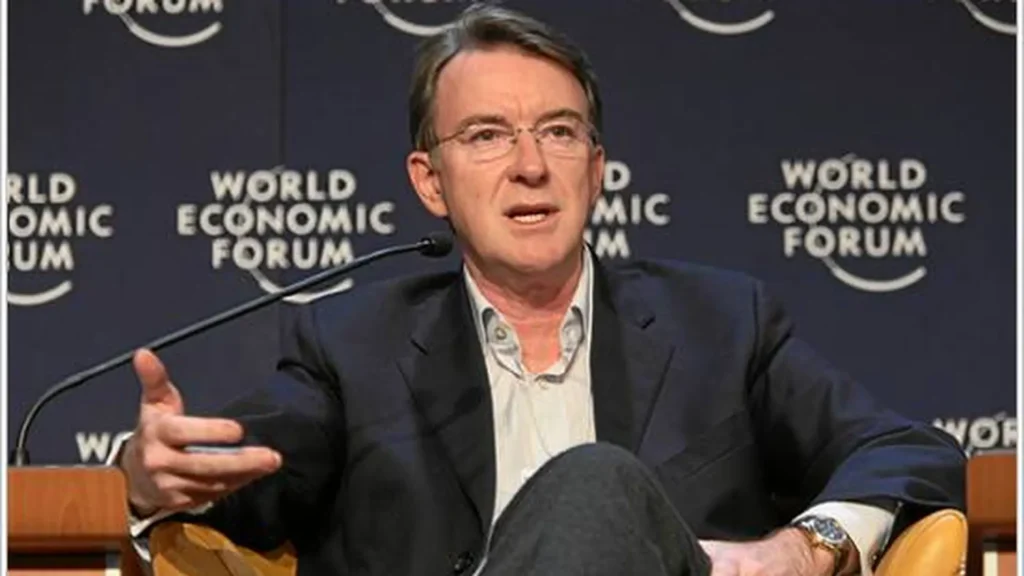
Mandelson Held Lobby Firm Shares for Months as US Envoy
Last Updated on November 26, 2026 10:34 pm by Janson
Newly released government papers show Lord Peter Mandelson held on to his shares in Global Counsel, the lobbying firm he co-founded, for months after becoming Britain’s ambassador to the United States, even though senior civil servants warned the holding created a perception of conflict of interest.
The documents, published by the Cabinet Office on Thursday, are the third batch of papers about Mandelson’s appointment to be released. They show the former ambassador remained a shareholder until February 2026, a year after he took up the Washington post, because he believed the firm had not offered him a fair price.
Mandelson was named as ambassador in December 2024 and started the job the following February. He was dismissed in September 2025 after revelations about his friendship with Jeffrey Epstein, the late financier convicted of sex offences.
Officials warned of a conflict risk
In a letter dated 6 March 2025, Sir Olly Robbins, then the Foreign Office’s most senior civil servant, told the deputy head of mission in Washington, James Roscoe, that Global Counsel had made no offer for the shares that Mandelson regarded as fair value. Because the company was privately owned, Robbins wrote, Mandelson had no public markets solution for selling his holding.
Robbins said Mandelson expected another consultancy group to bid for the whole company later that year, which would have allowed him to sell out completely. In the meantime, officials set up monitoring arrangements under which the deputy ambassador would watch for conflicts of interest.
Other papers show civil servants doubted as early as January 2025 whether the shareholding could be kept separate from his work. One official questioned whether a blind arrangement could work when Mandelson knew he still owned the equity, whose value was tied to the firm’s fortunes.
The China speech and the quiet lunch
The papers also show Mandelson stayed in close contact with the firm while he was ambassador. In August 2025 he sent a draft of a public lecture to an unnamed Global Counsel director, who suggested softening his criticism of China and toning down his praise for Donald Trump’s administration. Mandelson agreed to make the changes.
In April 2025 he tried to arrange a discreet lunch between one of Mr Trump’s economic advisers and a member of the lobbying firm, writing that keeping the gathering under the radar would suit best. He then forwarded the emails to a Global Counsel employee to check whether the date worked.
Global Counsel’s clients included companies with links to China, among them the pharmaceutical firm WuXi AppTec, the online retailer Shein and the social media platform TikTok. The correspondence does not show that British policy changed as a result of the contacts, or that the firm gained financially from them.
A sale that never happened
By August 2025 the hoped-for sale of the firm had collapsed. Robbins told the then foreign secretary, David Lammy, on 26 August that the expected buyer had pulled out and the firm was seeking finance for an alternative offer, while Mandelson maintained that the price on the table did not reflect the value of his shares.
In July, after a journalist asked about the holding, Mandelson wrote to the firm: “They should pull their fingers out and buy my shares.” He remained a shareholder into February 2026. Global Counsel went into administration earlier this year, after a Financial Times investigation into Epstein’s role in setting the company up in the early 2010s.
The papers also record pressure to move the appointment quickly, with one official suggesting conflict-of-interest controls could be applied in a light-touch manner. MPs concluded in July that putting Mandelson in the role had been nothing short of disastrous.
Mandelson is under investigation by the Metropolitan Police over claims that he passed government papers to Epstein while he was business secretary, and he was arrested in February on suspicion of misconduct in public office. He has not commented on the latest release of documents. The affair has renewed questions about how Britain vets its most senior diplomats, a subject that also runs through our report on Britain’s new treaty deal with the EU and the fall in UK net migration to its lowest level since 1997.