
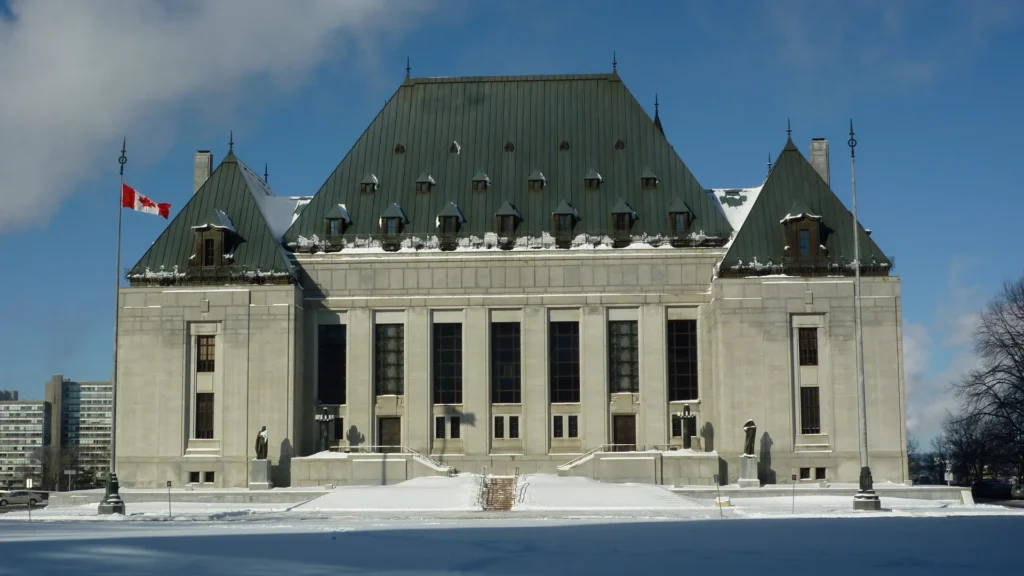
Supreme Court Upholds Quebec’s Bill 21 With One Exception
Last Updated on November 27, 2026 8:25 pm by Ayesha
Canada’s Supreme Court has upheld Quebec’s controversial secularism law, Bill 21, ruling that the province validly used the Constitution’s notwithstanding clause to shield it from Charter challenges, with one exception.
The ruling is a landmark in Canadian constitutional law, not only for what it says about Bill 21 but for what it says about the notwithstanding clause, which lets legislatures override certain Charter rights for renewable five-year periods. The court confirmed that Quebec’s pre-emptive use of the clause was lawful, and that the override is subject to no limits other than those written into its text.
Bill 21, formally the Act respecting the laicity of the State, bars public servants in positions of authority, including teachers, police officers and judges, from wearing religious symbols such as hijabs, turbans, kippahs and crosses while at work, and requires them to perform their duties with their faces uncovered. Critics, including the Canadian Civil Liberties Association, say it disproportionately targets Muslim women and other religious minorities. Supporters say it protects the secular character of the state.
What the court decided
The case, English Montreal School Board v. Attorney General of Quebec, reached the Supreme Court after working through every level of the Quebec courts. The Superior Court ruled in April 2021 and largely dismissed the challenges, with two exceptions. The Quebec Court of Appeal upheld the law in February 2024 and removed the exception the lower court had granted to English-language schools.
The seven-judge bench delivered its judgment, neutral citation 2026 SCC 41, at 9:45 a.m. Eastern on Friday. On the central question, the court was clear: the Quebec legislature had validly used the override clauses in section 33 of the Canadian Charter and section 52 of Quebec’s Charter of human rights and freedoms. There was one exception. Section 8 of the law infringes the democratic rights set out in section 3 of the Charter, the court held, to the extent that it applies to members of Quebec’s National Assembly. The ban on elected members wearing religious face coverings cannot stand, because it interferes with the democratic rights of elected representatives.
The notwithstanding clause survives intact
The most far-reaching part of the ruling concerns the notwithstanding clause itself. The appellants had asked the court to impose limits on how governments can use the clause, which has been invoked with growing frequency in recent years by Quebec, Ontario, Alberta and Saskatchewan. The court declined, holding that the exercise of the override power is not subject to any limit other than those expressly set out in its text, and that Quebec’s pre-emptive use of it was valid.
But the court also rejected the provinces’ argument that the clause shuts the courts out entirely. Four judges held that a court can rule on a law’s consistency with the Charter despite the invocation of the override, and can issue a declaration that a law is inconsistent with the Charter, even though such a declaration does not invalidate it. In this case, however, the court chose not to make a declaration. The court also rejected arguments based on sex equality and minority-language education rights.
What happens next
The ruling settles the law for now, but its consequences will play out across the country. For Quebec, Bill 21 will remain in force, subject only to the exception for elected members of the National Assembly. For other provinces, the confirmation that the clause can be used pre-emptively, and without substantive limits, removes a major uncertainty. The next test may come in March, when the court hears a case on Saskatchewan’s 2023 pronoun law, which also relies on the clause. For the challengers, the ruling is a defeat, though the court’s recognition that judges may still declare a shielded law inconsistent with the Charter gives them a tool for future cases. A second judge has blocked the birthright citizenship order in the United States, while the United States has delayed its review of its force posture in Europe.