
Tiny Cars Are Taking Off Across Europe as Teens Take Wheel
Last Updated on November 27, 2026 6:27 pm by Tayyab
They are barely bigger than a golf cart, they cannot go faster than 45 kilometres an hour, and they are banned from motorways. Yet tiny cars are taking off across Europe, and the people buying them are not who you might expect. Once the preserve of elderly drivers in the countryside, the licence-free microcar has become the vehicle of choice for European teenagers.
The numbers tell the story. In France, registrations of these small cars have risen from about 13,000 in 2019 to around 25,000 last year. Across Europe, sales have doubled in five years, from 30,000 to 60,000. Teenagers now account for a quarter of all mini-car sales, and at Ligier, one of France’s two big makers, young people make up 40 per cent of customers. The change has been so fast that the industry has a phrase for it: mobility that was imposed on people has become mobility that people choose.
Why teenagers love them
The appeal is simple. These cars are classed as motorised quadricycles, four-wheeled mopeds in the eyes of the law, which means they can be driven far younger than a normal car. In France and Italy, a 14-year-old can drive one after a road safety certificate and eight hours of training. In Germany and Spain the minimum age is 15, and in Britain it is 16. For a teenager in a rural area with no bus service, that is freedom: a roof over their head, room for a friend, and no need to wait for a parent to drive them to school.
How the Ami changed everything
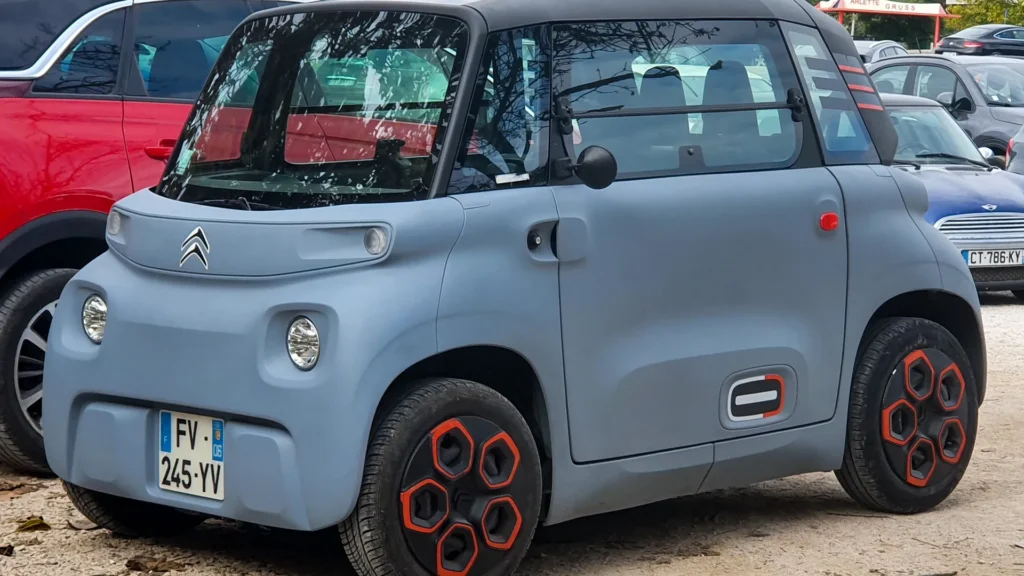
The turning point was the launch of the electric Citroen Ami in 2020. Before it arrived, the market was small, old-fashioned and largely invisible, serving older people in the countryside who had lost their driving licences. The Ami, with its boxy shape, bright colours and tiny price, made the category fashionable, and teenagers noticed. Its maker, Stellantis, is a giant next to the French specialists Aixam and Ligier, but its arrival helped them rather than hurting them: it put the whole category on the map, and their sales grew too.
The shift was helped by regulation. Stricter European Union rules on motorised two-wheelers made it too costly for manufacturers to keep building the mopeds and small scooters that had been teenagers’ vehicles of choice, and they have almost disappeared from the market since 2020. Licence-free cars moved in to fill the gap, and they had one big advantage over the mopeds they replaced: they are safer, and they keep the rain off.
Electric power has sealed the change. In 2026, more than 67 per cent of new licence-free cars are electric, according to market analyst Marie-Laure Nivot of AAA Data. The cars are cheap to run, easy to park in crowded towns, and exempt from many of the low-emission zone restrictions that now apply to older petrol cars in European cities.
A market finding its limits
The boom has not been without bumps. Sales in France, the biggest market, have flattened since the government withdrew subsidies for electric models, and some of the newer, more sophisticated minicars now cost as much as a small conventional car. Aixam has responded by investing 30 million euros in expanding its production capacity in France, betting that growth will come from other European countries even as the French market slows.
There are limits to what these cars can do. Their 45 kilometre an hour top speed makes them feel, to other road users, like mobile traffic calming, and they are forbidden on motorways and faster highways. But for their owners, that is the point: a 16-year-old in a rural village does not need a motorway, she needs to get to school and to her friends, and a tiny electric car does that in any weather. What was once a car for people who had no other choice has become a car people choose on purpose, and the youngest drivers in Europe are leading the way. India says its trade deal with the United States is nearing completion, while the French economy contracted in the third quarter of 2026.