
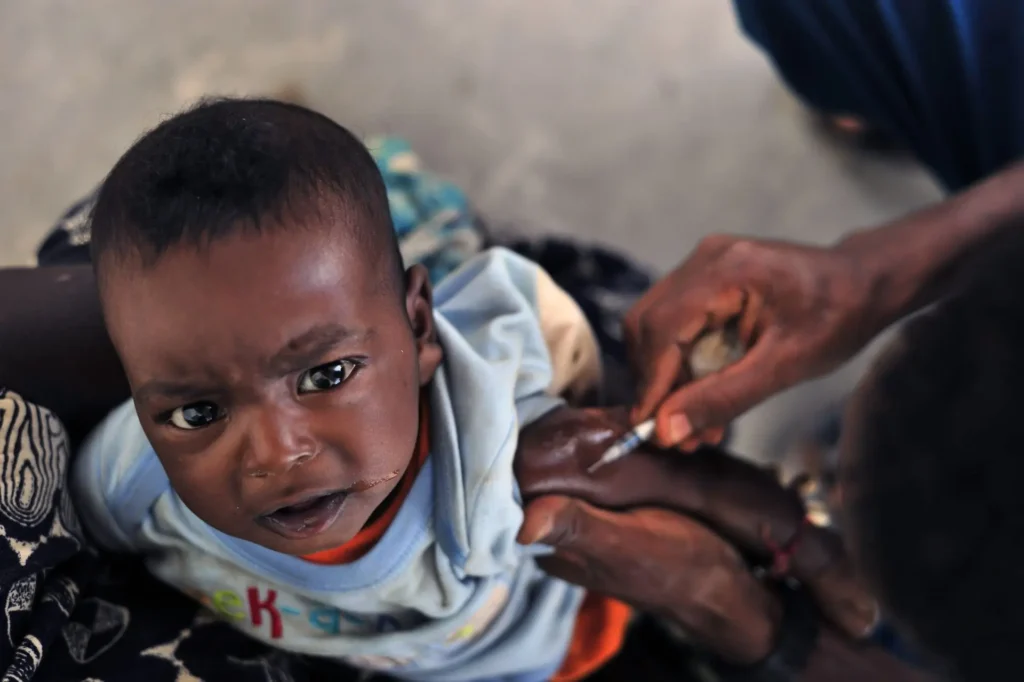
WHO Warns Measles Gaps Put South-East Asia Children At Risk
Last Updated on November 29, 2026 8:28 am by Alexa
The World Health Organization has called for urgent action to close measles immunity gaps in South-East Asia, after the region accounted for 47 per cent of estimated measles cases worldwide in 2025 despite recording the highest vaccination coverage anywhere in the world.
An estimated 4.6 million measles cases and 16,800 deaths occurred in the region in 2025, the WHO said in a statement issued on Saturday. The region achieved 96 per cent coverage with the first dose of measles-containing vaccine and 93 per cent with the second dose, yet approximately 1.1 million infants still missed their first dose.
The paradox, the WHO said, is that high averages can hide the pockets of unprotected children where the virus continues to spread. Measles is extremely contagious, and even small groups of unvaccinated or under-vaccinated people can sustain transmission and trigger outbreaks.
Outbreaks in five countries
Bangladesh, India, Nepal, Thailand and Maldives have all reported outbreaks and increases in measles cases, highlighting the continued risk posed by one of the most contagious diseases known to medicine. Continued endemic transmission and multiple outbreaks in 2026 have shown how fragile the region’s progress remains.
The gains of the past two decades are real. Measles cases in the region have fallen by 59 per cent and deaths by 90 per cent since 2000. But the WHO warned that those gains could unravel if the children missed by routine services are not found and vaccinated.
Dr Nilesh Buddha, Officer-in-Charge of the WHO South-East Asia Region, said high vaccination coverage at regional or national level could create a false sense of security if children and communities remain unprotected. Countries must ensure that every child receives both doses of the measles vaccine, wherever they live and whatever their circumstances, he said.
Reaching the children who are missed
Closing the gaps will require sustained work to strengthen routine immunisation, ensure both doses are given on time, and reach zero-dose and under-immunised children through targeted catch-up campaigns. Better use of district-level data can help identify underserved communities and susceptible groups, including older children and adolescents who may have missed vaccination opportunities.
The WHO also pointed to groups at the highest risk of missing out, including migrants, mobile and border populations, people in remote and underserved urban areas, conflict-affected and displaced communities, and groups affected by vaccine hesitancy. Immunity gaps acquired in childhood can persist into adulthood, leaving older age groups susceptible and contributing to continued transmission, and the WHO said countries should explore opportunities to extend vaccination to adults.
Strong surveillance systems are equally critical, the WHO said, to detect cases early, confirm infections through laboratory testing and track transmission through genomic surveillance. Timely outbreak investigation, response immunisation, clear communication to counter misinformation, and sustained political commitment and financing will all be essential to interrupt transmission.
Four countries have eliminated measles
There are success stories to build on. By the end of 2025, four countries in the region, Bhutan, Maldives, the Democratic People’s Republic of Korea and Timor-Leste, had been verified as having eliminated measles, showing that elimination is achievable with sustained effort.
The regional target of eliminating measles and rubella will require countries to ensure that no community is missed and no immunity gap is left open, the WHO said. The goal must be not just high coverage, but no missed communities, no immunity gaps and no preventable deaths.
The warning comes as measles remains a global concern, with the United States recording nine deaths, its highest toll in 35 years, even as global measles deaths hit a historic low. The South-East Asia figures show that averages can mislead, and that the children hidden inside the statistics are the ones who need the vaccine most. Readers can follow the wider picture in our coverage of nine measles deaths in the US, a 35-year high, measles deaths at a historic low worldwide, and the NHS warning over a flu spike and hospital admissions.