
North Korean Troops Cross Border 40 Times in Two Months
Last Updated on November 27, 2026 2:58 pm by Alexa
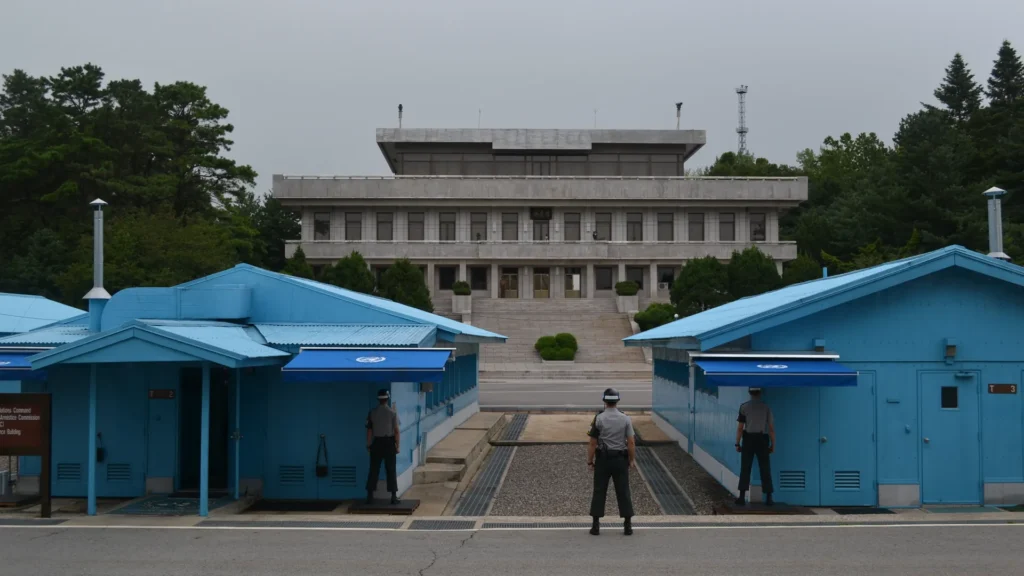
North Korean troops have crossed the heavily fortified inter-Korean border about 40 times in the past two months, South Korea’s military has revealed, in a steady drumbeat of incursions that Seoul’s daily warning shots have failed to stop.
The military detected about 30 crossings in October and about 10 more in November, according to data on North Korea’s border fortification work and military demarcation line incursions that the Joint Chiefs of Staff submitted to Representative Yu Yong-weon of the opposition People Power Party, a member of the National Assembly’s National Defense Committee, on Friday.
The figures continue a trend that has been building all autumn. The Joint Chiefs had earlier told Yu’s office that North Korean troops crossed the line about 20 times in August and about 30 times in September. The incursions have kept coming even after the North’s mine provocation in the demilitarised zone in September, when two North Korean antipersonnel mines exploded about 10 metres south of the line in Paju, injuring three South Korean officers who were clearing a new patrol route.
Warning shots that do not deter
Under its rules of engagement, the South Korean military broadcasts warnings when North Korean troops approach the line and fires warning shots when they cross it. The data released on Friday suggests those measures are not working as a deterrent. Even though the military says it fires warning shots every day, the incursions are not decreasing, a point Yu made in criticising the current response and calling for stronger countermeasures.
The crossings happen as North Korean troops carry out what Pyongyang calls border fortification work. The North began the work along the demarcation line in April 2024, after it defined inter-Korean relations as those between two hostile states, abandoning decades of talk about eventual reunification. Along with laying mines on a massive scale, the North is clearing land to create barren zones, building walls, installing tactical roads and barbed-wire fences, and cutting off the Gyeongui and Donghae road and rail corridors that once linked the two Koreas.
South Korean military data shows Pyongyang has planted 960,000 land mines since 2024 as it attempts to fortify the border. The September blast that injured the three officers was the most serious consequence so far, and the Joint Chiefs chief has called it a provocation. Pyongyang has denied responsibility for the mines and insists Seoul fabricated the incident.
A border frozen in hostility
The dispute has now reached the United Nations. Pyongyang sent a letter to the Security Council repeating its accusation that Seoul fabricated the September landmine incident, and warning that violations of its sovereignty could trigger self-defence measures. Seoul has proposed military talks with the North to establish a mutually recognised line, restore military communication channels and prevent accidental clashes, but a response looks unlikely.
Kim Yo-jong, the sister of North Korea’s leader, has accused UN Secretary-General António Guterres of siding with Seoul after he called for renewed inter-Korean dialogue, calling him prejudiced and irresponsible. The exchange underlines how little room for diplomacy remains: the two sides cannot even agree on where the line runs, let alone on how to stop soldiers crossing it.
The risk of a miscalculation
For the soldiers on the front line, the risk is that a routine encounter turns into something worse. Each crossing is met with a warning shot, and each warning shot is a moment in which a misunderstanding could escalate. The line has held for more than 70 years, but the data released on Friday shows it is being tested more often than at any time in recent years. Kim Jong Un has urged wider deployment of tactical nuclear weapons, while Taiwan heads to the polls with the threat from China looming large — a region where every border is under strain.