
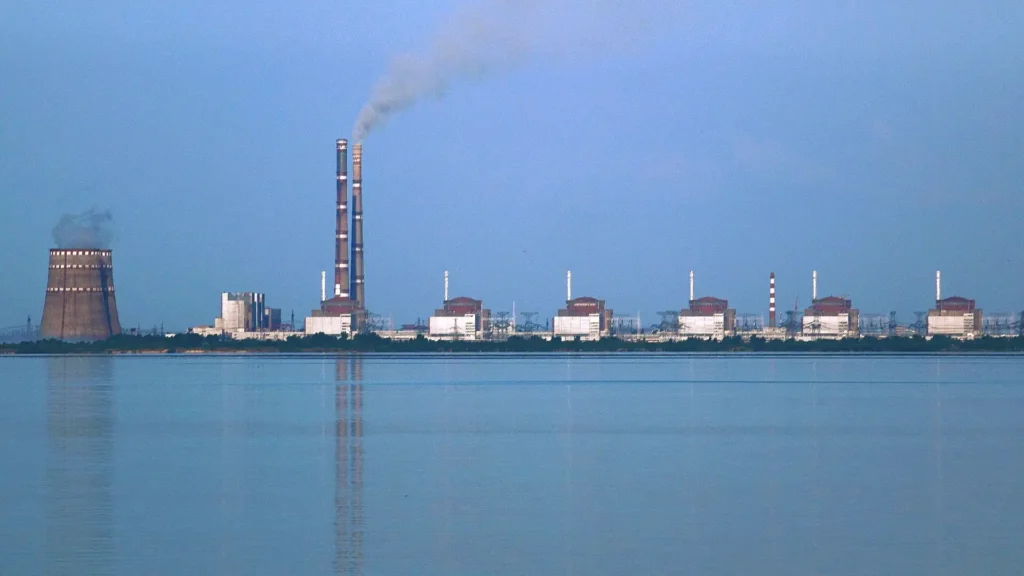
Zaporizhzhia Nuclear Plant Loses Power for 28th Time in War
Last Updated on November 26, 2026 6:28 pm by Tayyab
Europe’s largest nuclear power plant has lost all external electricity for the 28th time since the war began, forcing operators to run essential safety systems on emergency diesel generators as Russian strikes knocked out power across five Ukrainian regions.
The Zaporizhzhia Nuclear Power Plant lost its connection to its only remaining external power line at 5:28 in the morning on Wednesday, 25 November, the International Atomic Energy Agency said. The plant’s own needs are now covered by backup diesel generators, on which its nuclear safety and physical protection systems depend.
Ukraine’s nuclear operator, Energoatom, said the last power line was cut by Russian shelling. The IAEA said its team at the site is investigating the cause and the precise location of the disconnection.
What happened to the last power line
The line that failed was the 330 kilovolt Ferrosplavna-1, the plant’s sole remaining link to the outside grid. Energoatom said a Russian strike severed it at 4:28 in the morning, about an hour before the IAEA recorded the loss of connection. The agency has not yet confirmed the cause, and its inspectors on site are working to establish exactly where the line was disconnected.
“The Zaporizhzhia NPP is using emergency diesel generators to provide critical nuclear safety and security functions after losing external power for the 28th time since the conflict began,” the IAEA said, quoting its Director General, Rafael Grossi.
All six reactors at the plant are shut down and are not generating electricity. But the nuclear fuel inside the reactors and in the spent fuel pools still needs constant cooling, and that cooling needs electricity. Without an external supply, the pumps run on emergency diesel generators, which depend on fuel supplies and on equipment that was not designed to run this way for long.
The previous blackout happened on 8 November, when the same line disconnected and automatic reconnection failed. The situation has now repeated itself less than three weeks later.
A plant running on borrowed time
This was the 17th loss of external power at the plant since the start of 2026, according to Ukraine’s Deputy Energy Minister, Artem Nekrasov. That makes 2026 the worst year of the war for blackouts at Zaporizhzhia: 17 of the 28 total losses during the war have happened this year, compared with 11 across all the previous years of occupation.
Ukraine’s military intelligence reported in October that the plant’s cooling pond has dropped well below the minimum level required for full station needs, that diesel reserves are minimal, and that staffing has fallen to roughly half of pre-invasion levels. Each new blackout therefore carries more risk than the last, because the systems that are supposed to carry the plant through an outage are themselves running low.
Operators have warned repeatedly that relying on diesel backups raises the risk of a nuclear accident, and Ukrainian officials say the danger can only be removed by returning the plant to Ukrainian control. The plant has been under Russian occupation since the early weeks of the full-scale invasion, and the IAEA has kept inspectors there throughout.
A wider night of strikes
The blackout at Zaporizhzhia was part of a wider night of attacks on Ukraine’s energy system. Overnight and on the morning of 25 November, Russian forces again struck power plants and substations, causing outages in the Dnipropetrovsk, Donetsk, Zaporizhzhia, Odesa and Kharkiv regions. The situation is hardest in Zaporizhzhia and Dnipropetrovsk, according to the Energy Ministry.
At least five people were killed and dozens wounded across the country, and rolling power cuts were imposed as winter approaches. A thermal power plant stopped operating, and a gas facility in the Poltava region caught fire.
The strikes came on the same night that Russian forces hit Kyiv with ballistic missiles, striking a shopping centre and two other buildings, in an escalation that has also seen Russian missiles hit grain ships near Odesa and a Ukrainian raid sink a Russian warship off Libya. For the engineers at Zaporizhzhia, the immediate task is narrower and more urgent: keep the diesel generators running, and the fuel inside them cooling, until the line can be repaired.