
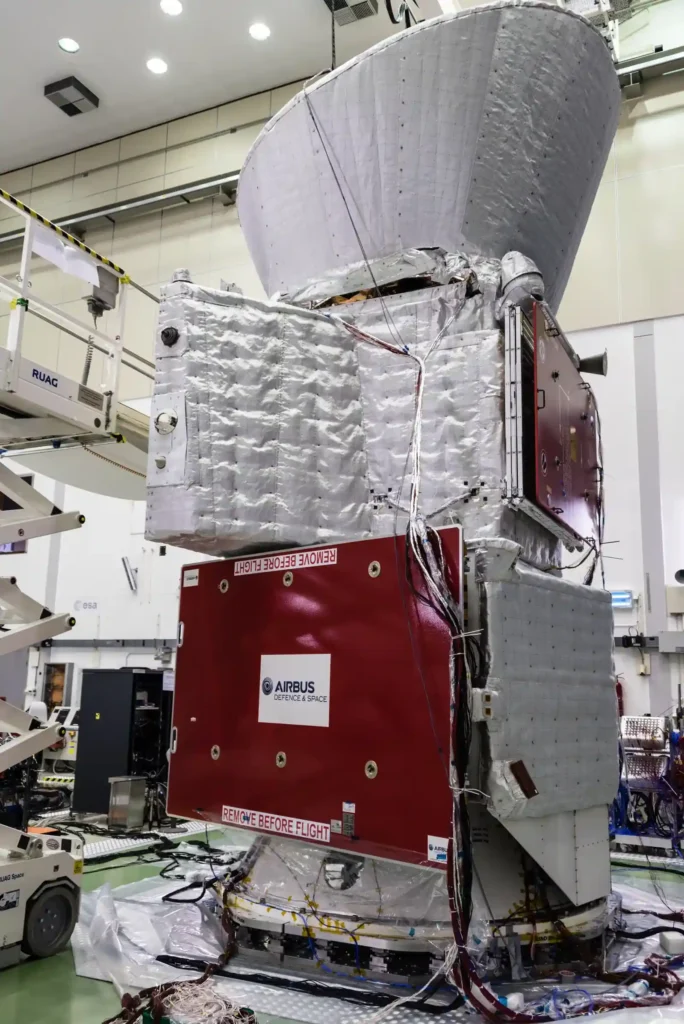
BepiColombo Reaches Mercury Orbit Despite Software Glitch
Last Updated on November 29, 2026 1:46 am by Bilal
The European-Japanese spacecraft BepiColombo has reached Mercury after an eight-year journey, entering orbit around the solar system’s innermost planet despite a software glitch that cut its braking burn short and left it in a higher orbit than planned.
The joint mission of the European Space Agency and the Japan Aerospace Exploration Agency was successfully inserted into orbit around Mercury on November 21, after travelling through space since its launch in October 2018. It is the first visit to Mercury by a Japanese or European spacecraft, and only the third mission ever to reach the planet.
A burn that ended too soon
The trouble came during the orbit insertion manoeuvre, the delicate braking burn that would turn a slow fly-past into a lasting orbit. At 18:24 UTC on November 21, as BepiColombo passed just 635 kilometres above Mercury’s surface, its four axial thrusters began firing as planned. The burn was expected to last 37 minutes.
Instead, it stopped after just 28 minutes. A software issue on board the European Mercury Planetary Orbiter caused the thruster firing to end earlier than planned, and the spacecraft entered safe mode, a protective state that shuts down all non-essential activities. Contact was lost on schedule during the manoeuvre, so for hours the team at the European Space Operations Centre in Darmstadt, Germany, did not know whether the probe had slowed enough to be captured by Mercury’s gravity or had simply flown past.
After four hours of data analysis, the team finally confirmed that the partial burn had put BepiColombo into orbit, albeit not the intended one. The spacecraft had achieved only 77 percent of the planned change in speed, and instead of circling Mercury every 58 hours, it now takes 75 hours to complete each orbit. At its highest point, it will be about 10,000 kilometres higher than expected over the planet.
Lucky to be there at all
Engineers say the team was fortunate. BepiColombo arrived slowly enough to be captured by Mercury’s gravity with limited braking, using a technique called weak stability capture, the first time a craft has entered orbit around another planet this way. Without that gentle approach, the shortened burn could easily have meant missing the planet altogether.
An ESA official said the team was rather lucky, because the outcome could have gone much worse, and that the mission still managed to hit pretty much all of its orbital parameters. The spacecraft is healthy, and the orbit is expected to be corrected through a series of control manoeuvres designed to gradually lower its altitude.
The glitch has been traced to a software issue involving attitude guidance and thruster control, and teams at Darmstadt are working with the lead manufacturer, Airbus, to investigate it. Engineers calculated that the glitch had only about a one-in-six chance of occurring, an unlucky roll of the dice after eight years of near-flawless flying.
What happens next
Despite the altered orbit, the mission remains on track. The two science orbiters, ESA’s Mercury Planetary Orbiter and JAXA’s Mercury Magnetospheric Orbiter, known as Mio, are still scheduled to separate on December 9 in Germany, December 10 in Japan, with Mio’s protective sunshield detaching six days later.
Following additional manoeuvres to reach their final orbits, BepiColombo’s science phase is set to begin on April 6, 2027, and the mission is planned to operate until 2029. Scientists hope it will answer long-standing questions about Mercury, including why the planet has such a large iron core and how its magnetic field is generated.
The mission has already overcome serious trouble once before. A propulsion problem in 2024 forced engineers to rethink the route and delayed the arrival at Mercury by 11 months. That the two-billion-dollar spacecraft is now safely in orbit, even in the wrong one, is a triumph of persistence, and engineers say the altered orbit leaves less margin for further problems but will not stop the science, as SpaceX won FCC approval for a million satellites and an AI-guided search found super-catalysts in molecular cages. The mission also follows hints of a hidden structure in the vacuum.