
BepiColombo Reaches Mercury After Eight-Year Space Journey
Last Updated on November 27, 2026 5:23 pm by Usman
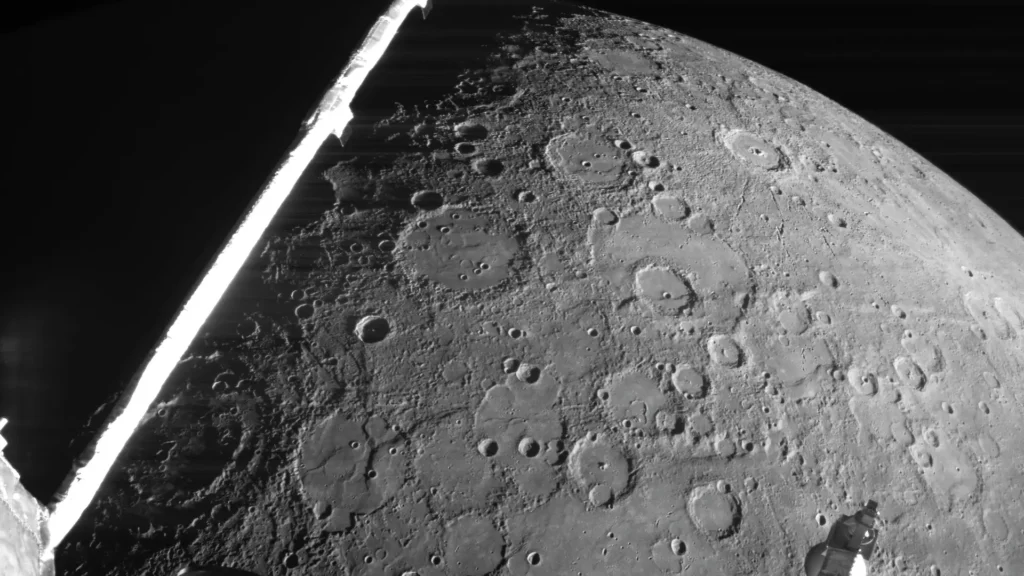
After an eight-year journey across the inner Solar System, the European and Japanese BepiColombo spacecraft has entered orbit around Mercury, becoming only the second mission in history to circle the Sun’s innermost planet.
The composite spacecraft fired its thrusters to enter orbit on Saturday 21 November, starting at 18:24 UTC, passing just 635 kilometres above Mercury’s surface as it made the manoeuvre with no contact with Earth. When the signal came back, the mission team found the spacecraft in safe mode: a software issue had cut the thruster burn short, delivering only about three-quarters of the planned manoeuvre. Despite the scare, BepiColombo was captured into orbit around Mercury, and the European Space Agency confirmed the mission is safe and on track.
The arrival is a major milestone for a mission that launched on 20 October 2018 from Kourou in French Guiana and has travelled one of the most complex routes ever flown, using nine gravity-assist flybys, one of Earth, two of Venus and six of Mercury itself, to slow down enough to be captured by the smallest planet’s gravity. It is also a first in its own right: BepiColombo is the first spacecraft to enter orbit around another planet using a technique called weak stability capture.
A tense arrival
The orbit insertion did not go entirely to plan. After the 37-minute burn was due to finish, the spacecraft was expected to reorient itself and re-establish contact with Earth at 21:37 UTC. No updates came for hours. It was not until 01:02 UTC on Sunday 22 November that ESA confirmed the signal had been received and that BepiColombo was in orbit around Mercury.
Follow-up statements revealed that a software issue in the attitude guidance and thruster control system on the Mercury Planetary Orbiter had caused the thrusters to shut down early, ending the manoeuvre ahead of schedule and leaving the spacecraft in safe mode. Engineers traced the cause within days and replanned the remaining manoeuvres, with no extra burns needed. ESA’s director general described the tense hours in a public update, noting that the spacecraft was in a stable orbit and still on course for the next steps of the mission.
Two orbiters, one mission
BepiColombo is actually two science spacecraft travelling together, one built by ESA and one by the Japan Aerospace Exploration Agency (JAXA). The pair are still joined together, and they will separate on 9-10 December, when the JAXA orbiter, called Mio, moves into its own elliptical polar orbit, tracing paths between 500 and 11,000 kilometres above the surface to study Mercury’s magnetic field and how it interacts with the solar wind.
The ESA-built Mercury Planetary Orbiter will then gradually descend over the following months, reaching its final orbit at between 400 and 1,500 kilometres around March 2027. Together, the two orbiters will give scientists their first close-up look at Mercury since NASA’s MESSENGER spacecraft, previously the first and only craft ever to orbit the planet, ended its mission in 2015.
What BepiColombo will study
Science operations are due to begin on 6 April 2027, and the mission is planned to run until 2029. The orbiters will study Mercury’s surface, its interior and its magnetic field, trying to answer questions about how the planet formed and why it has such a large iron core for its size, and how its thin exosphere and magnetosphere behave so close to the Sun.
The mission’s arrival also sets up a busy December, with the separation of the two orbiters the next major milestone, followed by months of careful manoeuvring into their final science orbits. For a mission that has already survived launch delays and a shortened arrival burn, reaching Mercury at all is an achievement in itself. China also launched its first Pakistani astronaut to its space station this week, while Hubble has mapped the Milky Way’s crowded heart for the Roman Telescope.