
Scientists Warn Super El Niño Nears Peak, La Niña In 2027
Last Updated on November 29, 2026 3:39 am by Muhammad
The Super El Niño of 2026 is close to its peak in the tropical Pacific and at record strength in the latest ocean data, but new long-range forecasts point to a rapid collapse in 2027, with a La Niña developing in its place that is likely to be a strong one.
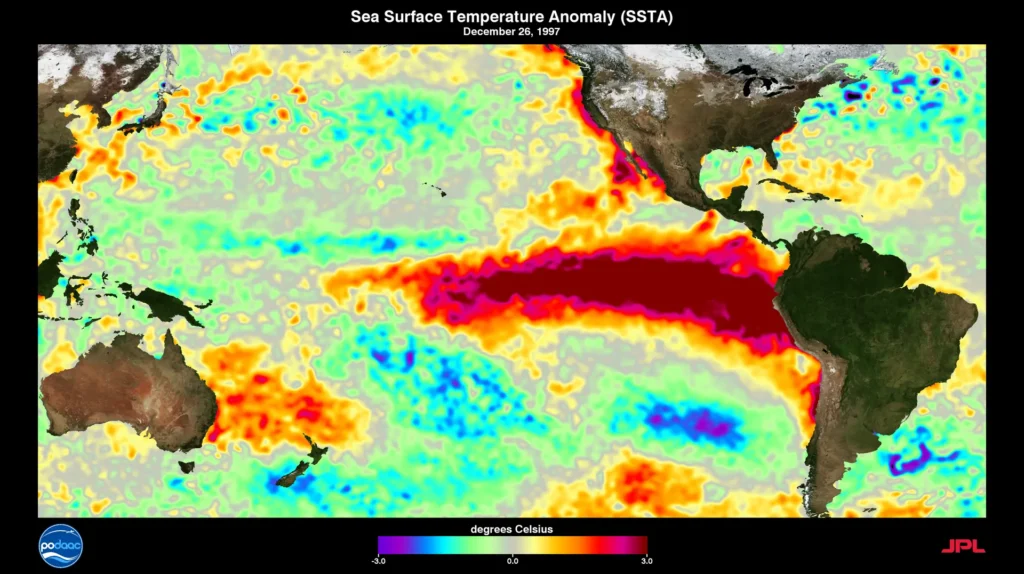
The latest analysis from NOAA ocean data shows the eastern Pacific covered in very strong warm anomalies, with peak warmth reaching well over 6°C above normal over a large area. The 2026 event has quickly surpassed the last Super El Niño of 2015-2016 in speed and strength, and has surpassed all events in recent decades in terms of raw ocean anomaly.
Yet below the ocean surface, the first signs of a rapid reversal are already emerging. In the top 200 metres of the eastern tropical Pacific, a powerful downwelling Kelvin wave carries peak anomalies of more than 10°C above normal, the underwater warm core of the Super El Niño. But in the western parts of the region, a cold anomaly is emerging, the result of strong westerly wind bursts that push warm water east and bring colder deep water up to replace it.
Models point to a fast reversal
The Climate Impact Company reached the same conclusion in its November outlook, issued on 10 November. It said the Super El Niño was peaking and expected a rapid demise in early 2027, with its preferred forecasts showing the event peaking in November, weakening rapidly in early 2027 and flipping to La Niña by the middle of the year. Its analog forecast has the event falling below Super El Niño criteria in February 2027, becoming a weak El Niño by April, and turning into La Niña in the middle third of 2027.
NOAA’s own outlook is more cautious about the timing. Its 12 November discussion said strong-to-very-strong El Niño conditions were more than 79% likely to persist through January to March 2027, and the World Meteorological Organization put the chance of the event persisting through December to February at near 100%. NOAA’s probabilities give La Niña no chance for February to April 2027, 13% for May to July and 33% for June to August, with ENSO-neutral conditions the more likely outcome through much of the transition.
Why the shift matters
La Niña typically follows a Super El Niño because the heat built up by the latter is pushed away from the equator at its peak. Four of the nine strong El Niños since 1950 were followed by a La Niña within a year, and model studies find that extreme La Niñas will nearly double in frequency under warming, mostly after extreme El Niños.
For now, the El Niño is firmly in control of weather patterns through winter 2026-2027 and into early spring. The winter pressure forecast shows its classic fingerprints: a low-pressure zone in the North Pacific and a blocking high-pressure area over Canada, the pattern seen in every major El Niño event. The NMME model mean peaks at 3.5°C in December, a record level.
The human cost is already visible. The World Food Programme has warned that 49 million people could fall into acute hunger as the event disrupts rains and harvests, and El Niño floods have already struck Piura in Peru and Ecuador, while the UN has named 16 hunger hotspots at famine risk partly because of El Niño.
What to watch in 2027
The disagreement between the models is about speed, not direction. The long-range models that track the cold water building below the surface expect a fast flip; NOAA’s probabilities expect a slower walk through neutral conditions first. Either way, the record-strong warming of 2026 is not expected to last. By the middle of 2027, the Pacific is expected to look very different, and the world’s weather, from monsoon rains to Atlantic hurricanes, will shift with it.
Forecasters will be watching the subsurface cold pool in the coming months. If it keeps growing, the collapse could come as fast as the buildup did, and the La Niña that follows could be one of the strongest in years.