
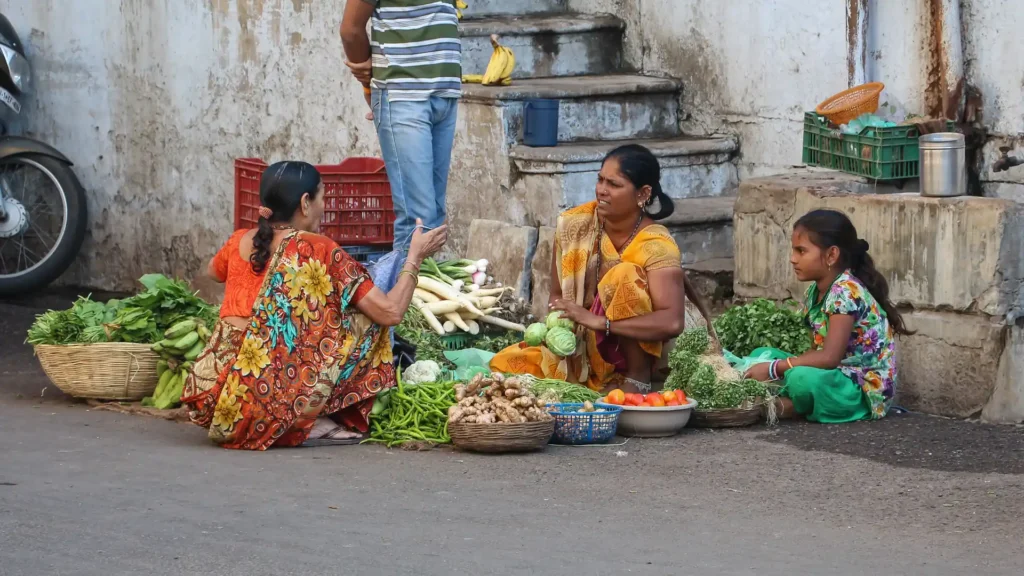
India’s Food Inflation Hits 8.94% as Poorest Families Suffer
Last Updated on November 27, 2026 2:58 pm by Sara
India’s inflation is rising again, and the biggest worry is what is happening to food prices. The latest government data shows retail inflation climbed to 6.09% in October, up from 5.54% in September. But look more closely at food inflation, and the picture is sharper still: it has surged to 8.94%, considerably faster than the overall rate.
The squeeze was sharper in rural India, where food inflation was 9.09%, compared with 8.68% in urban areas. Food accounts for a smaller share of Indian household spending than it once did, but it remains the biggest driver of inflation, with significant economic, social and political consequences. In India’s latest consumer price index, food and beverages account for 36.75% of the basket of goods and services used to measure inflation.
The numbers bear out who is hurting most. According to calculations by Dharmakirti Joshi, chief economist at analytics firm Crisil, the bottom 20% of rural households faced inflation of 6.9% in October, against 6.5% for the richest 20%. In urban India, the corresponding rates were 6.1% and 5.3%. Food inflation is never evenly felt, and in a country where the poorest spend the largest share of their earnings on the plate, they are feeling it first and most.
The thali test
The pressure is visible even in the cost of a simple meal. Crisil’s Roti Rice Rate analysis found that the cost of a home-cooked vegetarian thali, a meal platter, rose 12% year-on-year in October, driven by higher prices of onions, tomatoes, vegetables, edible oil, rice and cooking gas. A non-vegetarian thali became 9% more expensive.
Rice prices were up about 10% year-on-year, pulses 8%, edible oil 13% and cooking gas 10%, according to Pushan Sharma, director of intelligence at Crisil. The rise is no longer confined to a few volatile vegetables like onions and tomatoes. It has become broad-based, spreading into the staples that families cannot easily swap out, which is why the squeeze is being felt so widely.
For a poor household, there is simply less wiggle room when prices jump. Rajeswari Sengupta, an associate professor at Mumbai’s Indira Gandhi Institute of Development Research, points out that in a country where food still eats a hefty share of household income, adjustability is significantly lower than in richer countries. When rice, pulses and cooking oil all rise together, there is no cheaper alternative to switch to, only less food on the plate.
Weather, shortages and a weak monsoon
Food inflation this year has been driven by a combination of weather disruptions, supply shortages and rising input costs, economists say. With nearly 60% of its farmland dependent on rainfall, India remains acutely vulnerable to the vagaries of the monsoon. This year, the southwest monsoon was 13% below normal and unevenly distributed, while intensifying El Niño conditions have heightened risks to farm production.
Seasonal shortages and weak storage add to the price swings. Onion and tomato prices can rise sharply when supplies fall, while excess produce can go to waste when farmers cannot store or process it. Global edible-oil markets matter too, because India relies heavily on imports to meet its cooking-oil needs.
Some cushion, but the pressure spreads
There is some cushion. Government cereal stocks are above prescribed minimum levels, and a free-food programme covers nearly 800 million people, offering some protection against rising prices. But whether that offsets the squeeze on cooking oil or vegetables is something the reporting does not answer, and prolonged food inflation could push workers to seek higher wages and businesses to raise prices, spreading the pressure through the whole economy. India’s Supreme Court has ordered warning labels on junk food, while the US economy grew 4.3% in the third quarter as inflation stayed high — a reminder that the cost of living is rising on both sides of the world.