
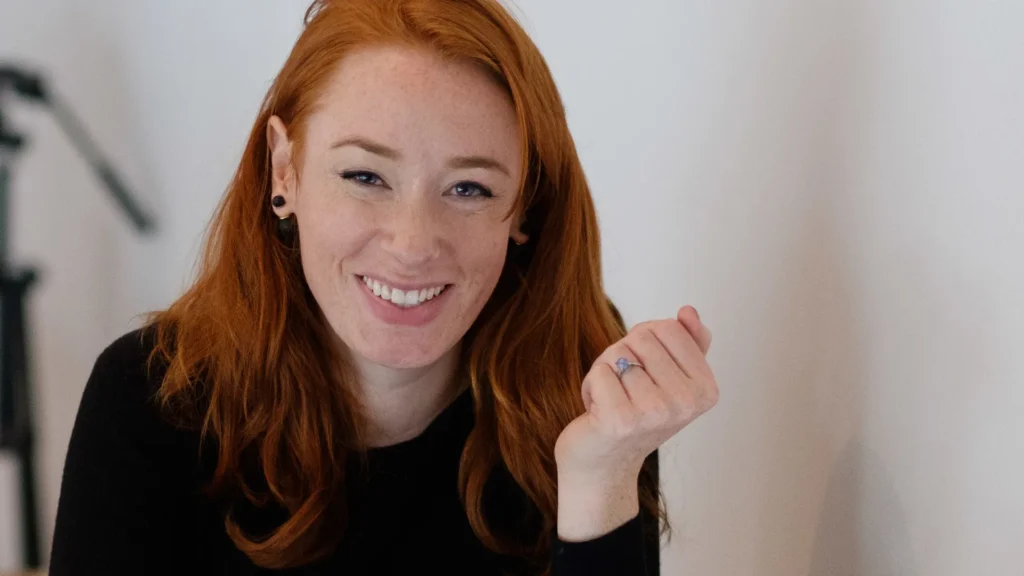
Hannah Fry ‘Unbelievably Lucky’ After Five-Year All-Clear
Last Updated on November 27, 2026 4:29 pm by Ayesha
Mathematician and broadcaster Hannah Fry has said she feels “unbelievably lucky” after receiving a five-year all-clear following treatment for cervical cancer.
The 42-year-old, who recently appeared in the second season of Celebrity Traitors, spoke about her diagnosis and recovery on BBC Radio 4’s Desert Island Discs, telling host Lauren Laverne that she had just been given the milestone result. “I had my five-year clear the other day. I feel so unbelievably lucky,” she said.
A screening delayed for months
Fry was 36 when cancerous cells were found after she attended a routine cervical screening in 2020, an appointment she had put off for months. Her GP called her back for a second test, and a biopsy confirmed the diagnosis. What followed was a radical hysterectomy in early 2021, carried out at a time when hospitals were under strict Covid-era visiting rules.
The hardest part, she said, was the uncertainty about whether the cancer had spread. She was told her chances of survival depended on whether the disease had reached her lymph nodes. If it had not reached any, the odds were in her favour. If it had reached one, her chance of survival would fall to 60 per cent, and if it had reached two, the odds would go against her, at 40 per cent.
While she was recovering in isolation in hospital, a surgeon told her that four of her lymph nodes had appeared enlarged. “I was in this hospital bed on my own and no-one could come and visit me for over a week, with nothing but the sheer terrifying drop of the end of my existence in front of me, it was horrific,” she said. She asked her then husband to set up FaceTime in the corner of a room so she could watch their two young daughters play, without letting them see her in the hospital bed.
Five years clear
The enlarged nodes turned out not to mean the cancer had spread, and Fry did not need chemotherapy or radiotherapy after the surgery. She did develop lymphedema, a lasting complication linked to the disruption of the lymphatic system after pelvic surgery, which she still manages today.
Reaching the five-year mark matters because it is the point at which doctors consider a patient substantially clear of the disease, with a much lower risk of recurrence. Fry described the experience, despite everything, as something she would not give up. “Going through something like that I don’t think I would swap it,” she said. “I think it was honestly such a gift to have that experience when you’re 36 and then come out the other side of it.”
Her experience later inspired the BBC documentary Making Sense of Cancer with Hannah Fry, in which she examined how medical statistics shape treatment decisions and how patients live with the long-term consequences of care. She also attended a Cancer Research UK reception hosted by the King and Queen at St James’s Palace in June, an event that brought together researchers, patients and supporters of the charity’s work.
A message about screening
Fry’s story carries a simple message that she has repeated since her diagnosis: go to the screening appointment. Her own cancer was found only because she eventually attended a test she had delayed for months, and the delay could easily have changed the outcome.
Cervical screening detects abnormal cells before they develop into cancer, and most cervical cancers are linked to high-risk human papillomavirus, or HPV. Fry’s case shows both sides of that story: the screening caught the disease in time for surgery to work, but the months of delay, and the week alone in a hospital bed waiting for news about her lymph nodes, were the parts she will never forget. A new flu drug has been approved in China, while a cheaper generic version of the HIV prevention drug lenacapavir has reached Zambia. For Fry, five years on, the result she waited for has finally arrived, and she counts herself lucky to be here to talk about it.